How AI is Revolutionizing Real Estate in 2025: Complete Guide to Artificial Intelligence Applications, Benefits & Implementation

Modern AI technology is revolutionizing every aspect of the real estate
industry, from property valuations to client communications.
Introduction
The real estate industry is experiencing its most significant technological
transformation since the advent of the internet. Artificial Intelligence (AI) is
no longer a futuristic concept—it's actively reshaping how properties are
valued, marketed, managed, and sold. With the global AI real estate market
projected to reach $731.59 billion by 2028 and 75% of U.S. brokerages
already adopting AI technologies, the question isn't whether AI will impact
real estate, but how quickly you can leverage it for competitive advantage.
What is AI in Real Estate?
Artificial Intelligence in real estate refers to the use of machine learning
algorithms, predictive analytics, natural language processing, and computer
vision to automate processes, enhance decision-making, and improve customer
experiences across all aspects of property transactions and management.
Unlike traditional software that follows pre-programmed rules, AI systems learn
from vast datasets to make intelligent predictions, identify patterns, and
continuously improve their accuracy. In real estate, this translates to
everything from automated property valuations with 95% accuracy to
intelligent chatbots that can qualify leads and schedule showings 24/7.
The Scale of AI Transformation
The numbers tell a compelling story:
Market Growth: AI real estate market valued at $226.71 billion in
2024, growing to $731.59 billion by 2028 (CAGR of 34.0%)Accuracy Improvements: AI boosts property valuation accuracy by up to
20% while reducing time from weeks to minutesOperational Efficiency: 30% increase in operational efficiency through
AI automationRevenue Impact: McKinsey predicts AI could add up to $180 billion to
real estate industry revenue
Top AI Applications Transforming Real Estate Today
1. AI-Powered Property Valuation & Automated Pricing
Traditional property appraisals can take days or weeks and often rely on limited
comparable sales data. AI-powered Automated Valuation Models (AVMs) are changing
this paradigm by analyzing millions of data points in real-time.
How It Works:
Data Integration: AI systems process public records, tax assessments,
recent sales, satellite imagery, neighborhood demographics, crime statistics,
school ratings, and social media sentimentMachine Learning Analysis: Advanced algorithms identify patterns and
correlations that human appraisers might missReal-Time Updates: Valuations adjust instantly as new market data becomes
available
Leading Examples:
Zillow's Zestimate: Achieves a 2.4% median error rate for on-market
homesHouseCanary: Provides institutional-grade valuations with impressive speed
Redfin: Combines AI with human expertise for enhanced accuracy
ROI Impact: AI-powered pricing optimization can increase property values
by 12% while reducing valuation time by 90%.
2. Predictive Analytics for Market Forecasting
AI's ability to analyze historical trends and current market conditions enables
unprecedented accuracy in forecasting future real estate trends.
Key Applications:
Price Trend Prediction: AI can forecast property price movements with
90% accuracyMarket Timing: Identify optimal buying and selling windows
Investment Analysis: Evaluate potential ROI for different property types
Risk Assessment: Predict market volatility and identify emerging
opportunities
Business Impact:
Investment decisions with 90% accuracy
Strategic portfolio optimization
Optimal project timing and location selection
3. Virtual Tours & Augmented Reality Experiences

Virtual reality and AI combine to create immersive property experiences with
real-time analytics and market insights.
Advanced Features:
AI-Enhanced Virtual Staging: Automatically furnish empty properties based
on demographicsIntelligent Object Recognition: AI identifies and highlights property
featuresPersonalized Recommendations: Suggest similar properties based on viewing
behaviorPredictive Visualization: Show potential modifications
Performance Results:
200% increase in property inquiries with AI-enhanced virtual staging
25% higher engagement rates with personalized virtual tours
Significant reduction in unnecessary property visits
4. AI Chatbots & Virtual Assistants for Lead Generation
Modern real estate chatbots powered by natural language processing provide
sophisticated lead qualification and customer service capabilities.
Advanced Capabilities:
Intelligent Lead Scoring: Automatically qualify prospects
Multilingual Support: Communicate in multiple languages
Appointment Scheduling: Coordinate showing schedules
Market Information: Provide instant neighborhood insights
Measurable Benefits:
33% enhancement in lead generation efficiency
24/7 availability ensures no leads are lost
Reduced response time from hours to seconds
5. Intelligent Property Management Systems
AI is transforming property management through predictive maintenance, tenant
screening, and automated operations.
Core Functions:
Predictive Maintenance: Analyze sensor data to predict equipment failures
Automated Tenant Screening: Evaluate applications with 90% accuracy
Energy Optimization: Reduce energy consumption by up to 20%
Rent Optimization: AI-powered pricing leads to 7% increases in rental
revenue
Operational Impact:
14% reduction in maintenance costs
9% boost in rental income
15% improvement in tenant satisfaction
Real-World AI Success Stories in Real Estate

Modern real estate professionals leverage AI tools and predictive analytics to
deliver superior client service and business results.
Case Study 1: Zillow's AI-Powered Market Dominance
Zillow's Zestimate tool processes over 100 million homes, providing instant
valuations that have become the industry standard.
Case Study 2: Compass's AI-Driven Agent Support
Compass developed AI tools providing market insights, client recommendations,
and transaction support to their agents.
Case Study 3: Entera's Automated Investment Platform
Entera's AI system handles over 1,000 monthly real estate transactions,
automating the entire residential investment process.
Proven Benefits & ROI of Real Estate AI Implementation
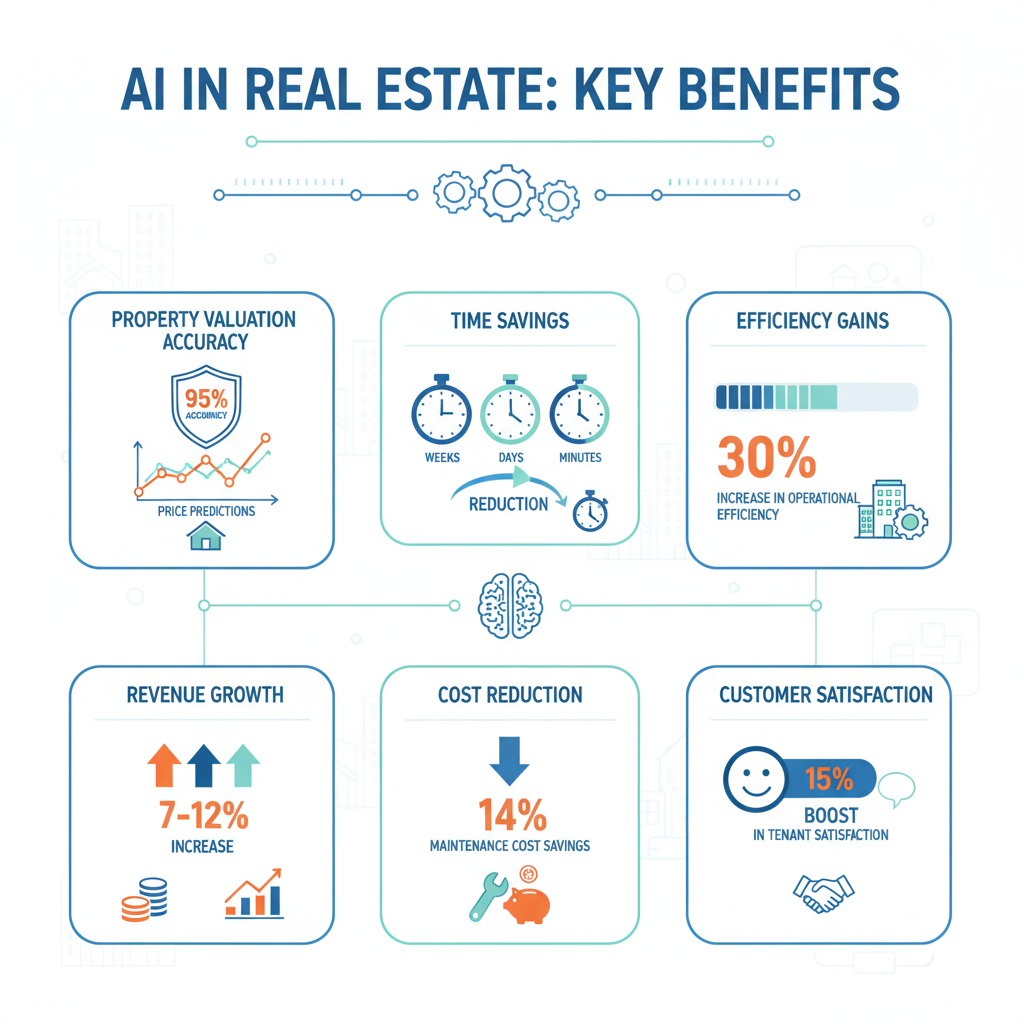
Comprehensive overview of measurable benefits and ROI from AI implementation in
real estate operations.
Financial Returns
Revenue Growth: AI implementation can increase revenue by 7-12%
Cost Reduction: 37% of real estate tasks can be automated
Time Savings: Reduce property valuation time from days to minutes
Operational Improvements
Accuracy Enhancement: Up to 20% improvement in property valuations
Process Efficiency: 30% increase in operational efficiency
Customer Satisfaction: 15% improvement in client retention rates
Competitive Advantages
Speed: Faster transaction processing
Scalability: Handle more clients without proportional staff increases
Data-Driven Decisions: Comprehensive market analysis
Current Challenges & How to Overcome Them
| Challenge | Solution |
|---|---|
| Data Quality | Implement robust data management systems |
| Implementation Costs | Start with specific, high-impact use cases |
| Regulatory Compliance | Work with legal experts to ensure compliance |
| Human-AI Balance | Use AI to enhance human capabilities |
Future of AI in Real Estate: Trends & Predictions for 2025-2030
Emerging Technologies
Generative AI: Create marketing content and virtual staging automatically
Blockchain Integration: Secure, transparent property transactions
IoT Connectivity: Smart buildings optimizing operations
Advanced Computer Vision: Automated property assessments from drone
imagery
Market Evolution
Real-Time Pricing: Continuous property value updates
Hyper-Personalization: AI-curated recommendations
Sustainable Focus: AI-driven energy efficiency
Global Accessibility: AI translation for international markets
Professional Impact
Enhanced Agent Roles: Focus on consultation and relationships
New Specializations: Demand for AI-savvy professionals
Continuous Learning: Adaptation to evolving AI capabilities
Getting Started: Your AI Implementation Roadmap
Phase 1: Assessment and Strategy (Months 1-2)
Audit Current Processes: Identify inefficiencies
Set Clear Objectives: Define goals and metrics
Budget Planning: Allocate resources
Phase 2: Pilot Implementation (Months 3-6)
Choose Starting Point: Begin with high-impact applications
Select Technology Partners: Work with experienced providers
Staff Training: Ensure team comfort with tools
Phase 3: Scale and Optimize (Months 7-12)
Measure Results: Track performance
Expand Applications: Add additional AI capabilities
Continuous Improvement: Regularly update systems
Recommended Starting Applications
Lead Management: Implement AI chatbots
Market Analysis: Use AI for valuations
Communication Automation: Streamline follow-ups
Conclusion & Next Steps
Artificial Intelligence isn't just changing real estate—it's completely
revolutionizing it. From 95% accurate property valuations to 30%
efficiency gains and the potential for $180 billion in additional industry
revenue, the opportunities are unprecedented.
The real estate professionals and companies that embrace AI now will lead the
industry in 2025 and beyond.
Take Action Today:
Assess Your Current Needs: Identify high-impact AI applications
Start Small: Choose specific use cases for initial implementation
Partner with Experts: Work with experienced AI solution providers
Invest in Training: Prepare your team for AI tools
Ready to transform your real estate business with AI? Contact US Tech
Automations today to discover how our specialized Real Estate AI Agents can
automate your workflows, enhance client communication, and drive measurable
business growth.
Tags
Related Articles

Real Estate CRM Automation: The System That Manages 500+ Leads Effortlessly
12 min read

Why Real Estate Automation Isn't Optional in 2025: The AI Revolution Transforming Property Workflows
13 min read

Automate CMAs & Listing Prep: A Straight-To-The-Point Playbook for Agents (2025)
9 min read
See how AI agents fit your team
US Tech Automations builds and runs the AI agents that handle this work end to end, so your team doesn't have to.
View pricing & plans