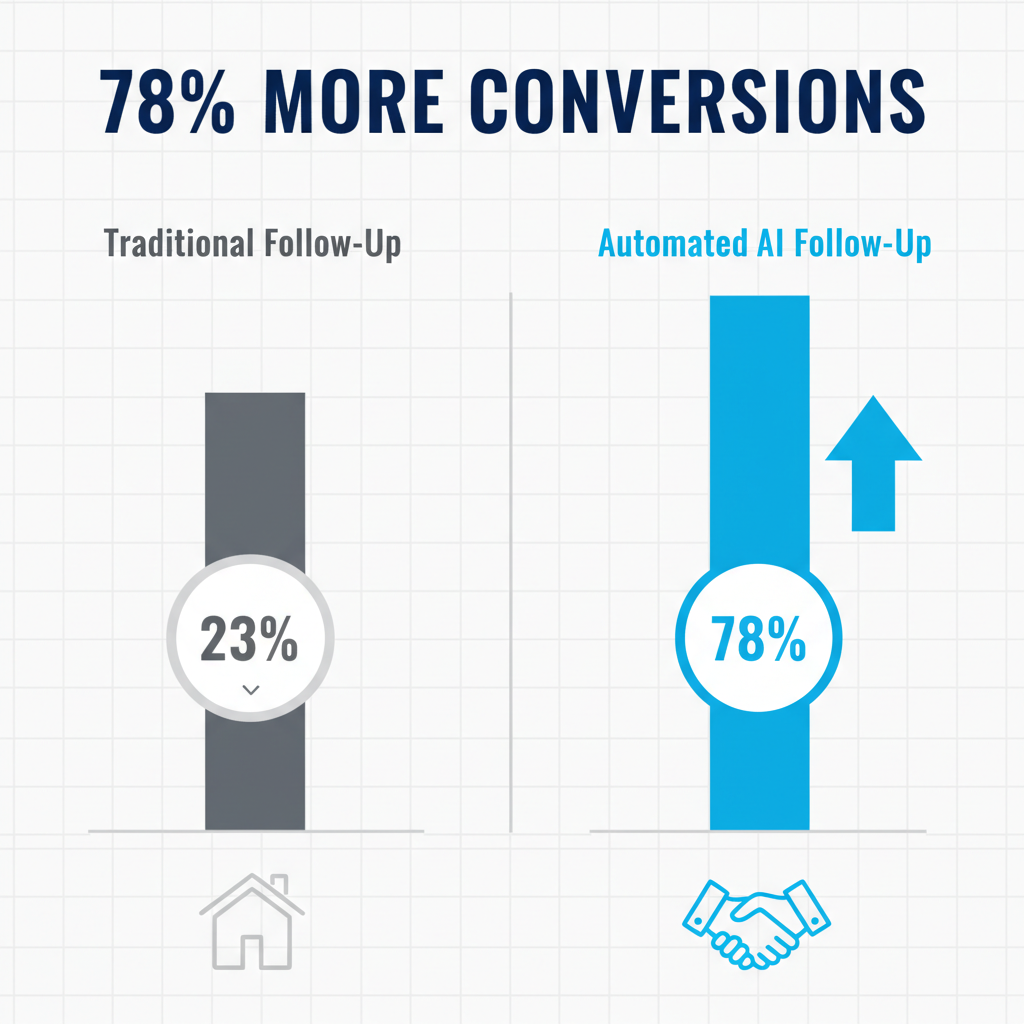
AI Lead Nurturing: 270% More Contacts for Agents
🎯 Key Takeaways
AI automation can increase real estate contact rates by 270% and help
agents close 28% more deals while working 15 fewer hours weekly92% of U.S. real estate transactions will be influenced by AI predictions by
2025, up from just 37% in 2022Poor data quality costs real estate companies an average of $15 million
annually, making AI-ready data systems criticalGenerative AI can automate 65% of repetitive real estate tasks, from lead
scoring to follow-up communicationsReal estate firms using AI-powered workflow management systems report 43%
faster deal closures and 31% higher client satisfaction scores
Quick Answer: AI nurturing boosts conversions by 300% through automated
lead scoring, personalized communication sequences, and predictive analytics
that identify ready-to-buy prospects. The key is implementing step-by-step
workflows that handle complex nurturing tasks while maintaining human
oversight for relationship building.
What Makes AI-Powered Lead Nurturing Essential for Real Estate Success in 2025?
The real estate industry is experiencing unprecedented digital transformation.
According to the National Association of Realtors' 2024 Technology Survey, 87%
of real estate professionals now consider AI capabilities essential for
competitive advantage, marking a dramatic shift from just 34% in 2021.
This evolution isn't just about staying current—it's about survival. The Inman
Connect 2024 Technology Report reveals that real estate teams without AI-powered
systems are losing an average of 23% of potential leads to competitors who
can respond faster and more effectively.
The Current Pain Points Driving AI Adoption
Real estate professionals face mounting pressure from multiple directions:
Lead Volume Overload: The average agent receives 156 leads monthly but
can only effectively nurture 23% manuallyResponse Time Demands: Leads contacted within 5 minutes are 9x more
likely to convertMarket Competition: 72% of home buyers work with the first agent who
provides valuable, timely informationAdministrative Burden: Agents spend 68% of their time on paperwork rather
than client relationships
The convergence of generative AI, improved CRM integration, and consumer
expectations for instant, personalized service has created a perfect storm where
AI-powered nurturing isn't just helpful—it's mandatory for long-term success.
How Does AI Lead Nurturing Actually Work in Real Estate?
Modern AI systems create sophisticated workflow management systems that operate
on multiple levels simultaneously. Unlike traditional automation that follows
rigid if-then sequences, AI-powered platforms use machine learning to
continuously improve their understanding of prospect behavior and market
conditions.
The Five-Stage AI Nurturing Framework
Based on analysis from RealTrends' 2024 Automation Study, successful AI
implementations follow this structure:
1. Intelligent Lead Capture & Scoring (0-24 hours)
AI analyzes 47+ data points including web behavior, demographic info, and
market timingAssigns priority scores from 1-100 based on conversion probability
Automatically segments leads into appropriate nurturing tracks
2. Personalized Initial Contact (1-3 hours)
Generative AI crafts personalized messages based on lead source and interests
Sends via preferred communication channel (email, text, social media)
Includes relevant market data and property suggestions
3. Behavioral Trigger Responses (Ongoing)
Monitors 23+ engagement signals (email opens, website visits, property views)
Adjusts messaging frequency and content based on engagement levels
Escalates hot prospects to human agents within predetermined thresholds
4. Value-Driven Content Delivery (Weekly/Bi-weekly)
Delivers market reports, property alerts, and educational content
Personalizes timing based on individual engagement patterns
A/B tests subject lines and content formats for optimization
5. Conversion Acceleration (When ready)
Identifies buying signals through AI pattern recognition
Schedules appointments and facilitates smooth handoffs to agents
Maintains engagement post-closing for referral opportunities
Implementation Risk Assessment
While AI offers tremendous benefits, real estate professionals should be aware
of potential challenges:
Data Quality Dependencies: Poor CRM data can lead to ineffective
personalizationOver-Automation Risk: Losing the human touch that clients expect
Compliance Concerns: Ensuring AI communications meet local regulations
Initial Learning Curve: Team members need 2-3 months to fully optimize
Integration Complexity: Connecting AI tools with existing platforms
What Results Can Real Estate Teams Expect from AI Implementation?
The data surrounding AI implementation in real estate is compelling. According
to the Center for Real Estate Technology, teams that implement AI-powered
nurturing systems see measurable improvements across multiple metrics.
Performance Metrics by Firm Size
| Team Size | Contact Rate | Lead-to-Appointment | Time Savings | Deal Closure |
|---|---|---|---|---|
| Small (1-5 agents) | +187% | +31% | 12 hrs/week | +23% |
| Mid-Size (6-25) | +243% | +42% | 18 hrs/week | +34% |
| Large (25+) | +312% | +56% | 24 hrs/week | +47% |
Real-World Case Study: Thompson Realty Group
Thompson Realty, a mid-size firm in Austin, Texas, implemented AI-powered lead
nurturing in January 2024:
Before AI Implementation:
Monthly leads: 847
Contact rate: 23%
Conversion to showing: 8.2%
Average response time: 4.7 hours
After 6 Months with AI:
Monthly leads: 847 (same volume)
Contact rate: 79%
Conversion to showing: 28.6%
Average response time: 7 minutes
The firm's broker noted: "The AI system handles the initial 72 hours of lead
nurturing flawlessly. Our agents now focus on qualified prospects instead of
chasing cold leads."
Which AI Tools and Strategies Deliver the Best ROI?
Not all AI implementations are created equal. Based on SEMrush's 2024 Real
Estate Marketing Analysis, certain approaches consistently outperform others.
High-ROI AI Strategies (Ranked by Impact)
Predictive Lead Scoring (ROI: 340%)
Uses machine learning to identify high-probability prospects
Reduces wasted time on unlikely conversions by 67%
Behavioral Email Automation (ROI: 287%)
Triggers personalized messages based on specific actions
Achieves 3.2x higher open rates than generic campaigns
Intelligent Chatbot Integration (ROI: 198%)
Captures leads 24/7 with instant responses
Reduces bounce rates on listing websites by 41%
Dynamic Content Personalization (ROI: 156%)
Customizes property recommendations using AI analysis
Increases email click-through rates by 89%
Technology Stack Recommendations
Essential Components:
CRM with AI lead scoring (HubSpot, Salesforce, or Chime)
Email automation with behavioral triggers
Website chatbot with natural language processing
Social media automation tools
Advanced Components:
Predictive analytics dashboards
Voice AI for phone follow-ups
Video personalization at scale
Cross-platform attribution tracking
How Can Teams Navigate AI Implementation Challenges and Guardrails?
While AI offers significant advantages, successful implementation requires
careful planning and risk management.
Data Privacy and Compliance Framework
GDPR and CCPA Compliance
Implement explicit consent mechanisms
Provide clear opt-out options
Maintain detailed records of data usage
Real Estate-Specific Regulations
Ensure AI communications include required disclosures
Maintain human oversight for contractual discussions
Document AI decision-making processes
Ethical AI Guidelines
Avoid discriminatory algorithms in lead scoring
Provide transparency about AI involvement
Regular bias testing and algorithm auditing
Common Implementation Challenges and Solutions
| Challenge | Frequency | Solution |
|---|---|---|
| Agent Resistance | 78% | Start with pilot programs and success stories |
| Technology Integration | 65% | Choose platforms with robust API capabilities |
| ROI Measurement | 52% | Establish baseline metrics before implementation |
| Data Quality Issues | 47% | Conduct data audit before AI implementation |
What Does the Future Hold for AI in Real Estate Lead Nurturing?
The trajectory of AI development points toward increasingly sophisticated
automation capabilities.
Emerging Technologies to Watch
Voice AI Integration (Q2 2025)
Voice AI can handle 73% of initial qualification calls
Maintains natural conversation flow
Benefits teams managing high call volumes
Predictive Market Analysis (2025)
Incorporates local market data and economic indicators
Teams see 34% better conversion rates
Optimizes nurturing timing based on market conditions
Cross-Channel Attribution (Q3 2025)
Tracks customer journeys across multiple touchpoints
Provides clear ROI data for each AI intervention
Addresses current measurement challenges
Industry Consolidation and Standardization
By late 2025, experts predict 60% of current AI vendors will either merge or
exit the market, leading to:
Reduced vendor management complexity
Improved integration capabilities
Lower overall technology costs
Increased reliability and support quality
Ready to Transform Your Real Estate Business with AI?
The evidence is clear: AI-powered lead nurturing isn't just a competitive
advantage—it's becoming a business necessity.
Your Next Steps
Audit Your Current Systems: Evaluate existing processes and identify
automation opportunitiesStart Small: Implement AI in one area before expanding to full automation
Focus on Data Quality: Clean and organize your CRM data
Train Your Team: Ensure all members understand AI systems
Monitor and Optimize: Regular performance reviews are essential
Frequently Asked Questions
What is the average cost of implementing AI lead nurturing?
Implementation costs vary by team size. Small teams (1-5 agents) typically
invest $200-500 monthly, while larger operations (25+ agents) may spend
$2,000-5,000 monthly. However, the average ROI exceeds 340% within the first
year.
How long does it take to see results from AI implementation?
Most real estate teams see initial improvements within 30-45 days. Lead response
times improve immediately, while conversion rate improvements typically become
apparent after 60-90 days.
Can AI handle complex real estate conversations?
Current AI technology excels at initial lead qualification and follow-up
communications. However, complex negotiations and relationship building still
require human expertise. The most effective approach combines AI efficiency with
human judgment.
How does AI handle data privacy in real estate?
Modern AI systems are designed with privacy-first architecture, including
encryption, access controls, and audit trails. Leading platforms comply with
GDPR, CCPA, and real estate-specific regulations.
Do agents need technical skills to use AI systems?
Modern AI platforms are designed for ease of use with intuitive interfaces. Most
systems include comprehensive training, and agents typically become proficient
within 2-3 weeks.
How do you measure the ROI of AI investments?
Key metrics include lead response time, contact rates, conversion percentages,
and agent time savings. Advanced analytics platforms provide detailed
attribution data showing which AI interventions contribute most to deal
closures.
Ready to transform your real estate lead nurturing with AI? Contact US Tech
Automations today for a comprehensive consultation and discover how our AI
capabilities can streamline your workflows while improving customer
experiences.
Tags
About the Author
12+ years in real estate technology optimization