29 Permits in 90731: Los Angeles ZIP Report
An alteration and repair permit is the paperwork behind a homeowner fixing what they already own — re-wiring a room, replacing a failing roof, reframing a wall, or upgrading a kitchen inside the existing footprint. In ZIP 90731, the San Pedro corner of Los Angeles, that single category is the story: it is the dominant permit type in the neighborhood, signaling a market of owners reinvesting in standing houses rather than developers breaking ground. Against that backdrop, the headline volume is modest and clear: ZIP 90731 recorded 29 residential permits in the May 11 – June 9, 2026 window.
Every figure in this report is a slice of the Los Angeles metro's sealed daily permit snapshot, filtered to the 90731 ZIP code. A building permit is a municipal authorization to perform construction, and a sealed snapshot is a point-in-time copy of public permit records that is hashed and stored before any analysis runs, so the numbers cannot drift after the fact. The data is cross-sectional: it describes one 30-day window and makes no claim about trends, because no comparable prior window exists in this series yet.
Scope: residential building permits (single-family and small multi-family); commercial and sub-trade permits are excluded at ingest. This is not a count of all construction permits issued in each city.
What the Numbers Say at a Glance
The short version: 90731 is a small-job, owner-driven pocket of a very large metro. Twenty-nine permits cleared in the window, the typical filing was valued in the low thousands, and roughly nine in ten of those permits fall under one heading — alteration and repair. There is no new-construction surge here and no concentration of large-dollar projects. It reads as a neighborhood of established homes whose owners are maintaining and modestly improving them, one trade scope at a time.
That pattern is exactly why a single ZIP is worth isolating. The Los Angeles citywide totals are enormous, and they average over neighborhoods that behave nothing alike. Pulling 90731 out of the metro snapshot turns a regional aggregate into something a contractor, supplier, or agent can actually act on at the street level.
Key Findings
ZIP 90731 recorded 29 residential building permits in the window, according to US Tech Automations' sealed permit snapshots.
Alteration and repair filings lead the ZIP with 26 permits, per the Los Angeles Department of Building and Safety via data.lacity.org (Socrata).
The median permit valuation in 90731 is $4,600, according to the sealed snapshot data.
Reported permit valuation in the ZIP totals $0.2M for the window, per the same Department of Building and Safety records.
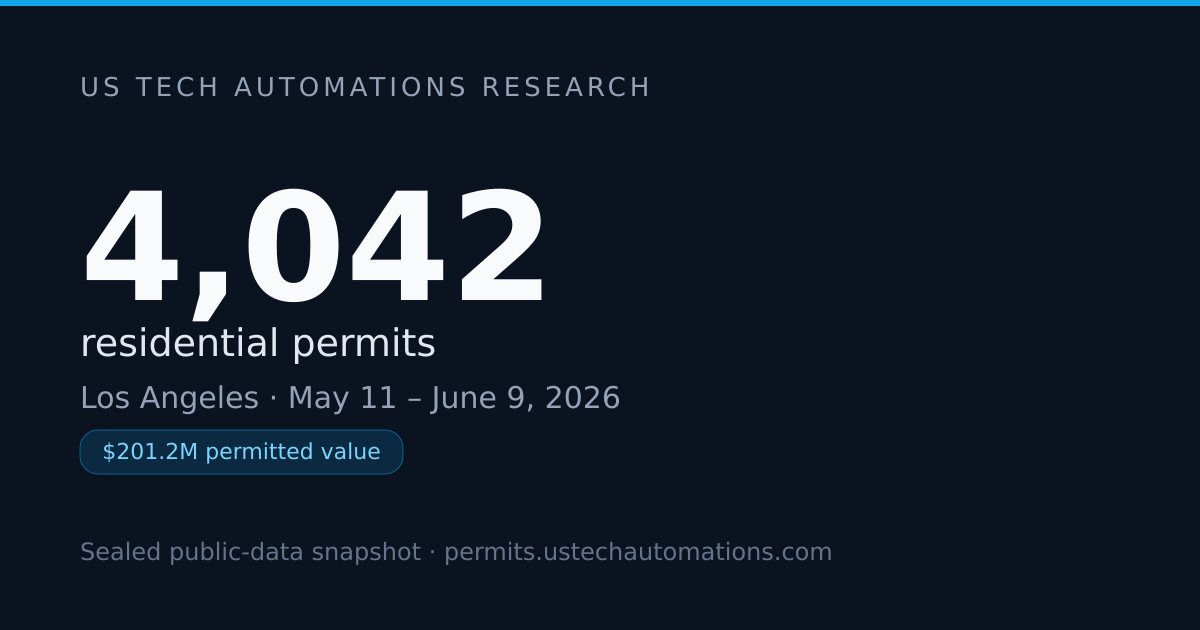
The ZIP sits inside a metro that logged 4,042 residential permits, according to the sealed Los Angeles snapshot.
ZIP 90731 logged 29 residential permits in the May 11 – June 9, 2026 window, with a median permit valuation of $4,600.
ZIP 90731 Permit Activity, May 11 – June 9, 2026
The table below is the 90731 slice of the sealed Los Angeles snapshot. Valuation figures reflect what applicants declared on their filings, not independent appraisals, and the compact valuation total is reported exactly as the snapshot rolled it up.
| Metric | Value |
|---|---|
| Residential permits issued | 29 |
| Total reported valuation (compact) | $0.2M |
| Median permit valuation | $4,600 |
| Reporting window | May 11 – June 9, 2026 |
A $4,600 median tells you most of what you need to know about scope. The typical permit here is a small, single-purpose job — the kind of work a homeowner schedules with one trade and finishes in days, not a gut renovation or a ground-up build. With 29 permits sharing a compact total of $0.2M, there is no long tail of multi-million-dollar projects pulling the average upward the way there is at the citywide level.
For anyone reading demand, that low and tight distribution is a feature, not a limitation. It points to recurring maintenance and improvement work — exactly the steady, distributed demand that keeps neighborhood electricians, plumbers, and roofers busy, rather than the lumpy, project-by-project flow of new construction.
What Is Getting Built in 90731
The dominant permit category in 90731 is Bldg-Alter/Repair / 1 or 2 Family Dwelling, shown below under its friendly label Alteration & Repair. In the window, that category accounts for 26 permits of the ZIP's 29 — nearly the entire slate.
| Permit category | Friendly label | Permits |
|---|---|---|
| Bldg-Alter/Repair / 1 or 2 Family Dwelling | Alteration & Repair | 26 |
| All residential categories | — | 29 |
In Los Angeles, an alteration-and-repair permit on a one- or two-family dwelling covers work that changes or restores an existing home without adding to its footprint or putting up a new structure. Typical triggers include rewiring or a panel upgrade, re-roofing, replacing or relocating plumbing, structural repairs after damage, window and door changes, interior reconfiguration, and kitchen or bath remodels. The common thread is that the house already exists and the owner is investing back into it.
Alteration and repair work accounts for 26 of the 29 residential permits filed in ZIP 90731 during the window.
That concentration says something specific about who is active here. A ZIP weighted this heavily toward alteration and repair is a neighborhood of owner-occupants and long-hold landlords maintaining their properties, not a development zone where builders are assembling lots. The work is spread across many small filings rather than a few headline projects, which is why the median valuation lands where it does.
For the trades, this is bread-and-butter demand. Remodels and repairs pull in electricians, plumbers, HVAC techs, roofers, and finish carpenters in sequence, and they tend to cluster — once one home on a block files, neighbors often follow. For suppliers, an alteration-heavy mix means demand for fixtures, lumber, roofing material, and finish goods rather than the structural volume a new-construction ZIP would generate. For agents, a steady stream of improvement permits is a pre-listing tell: owners who pull permits are often preparing to sell, or quietly raising the value of a home they intend to hold.
How 90731 Compares Across Los Angeles ZIPs
The 90731 figure only means something next to the rest of the metro. The table below places the ZIP alongside other active Los Angeles ZIP codes from the same sealed snapshot, plus the citywide headline row. Permit counts and compact valuation totals are copied verbatim from the snapshot.
| Area | Permits | Total valuation (compact) |
|---|---|---|
| ZIP 90272 | 388 | $66.2M |
| ZIP 90049 | 130 | $4.9M |
| ZIP 91344 | 95 | $2.4M |
| ZIP 90066 | 94 | $4.2M |
| ZIP 91367 | 90 | $6.0M |
| ZIP 91335 | 83 | $4.3M |
| ZIP 91364 | 79 | $1.5M |
| ZIP 91604 | 72 | $3.4M |
| ZIP 90042 | 71 | $2.0M |
| ZIP 90039 | 67 | $6.0M |
| ZIP 90731 | 29 | $0.2M |
| Los Angeles (all ZIPs) | 4,042 | $201.2M |
Read down the column and 90731 sits at the quiet end of the metro. The busiest ZIP on this list, 90272, logged 388 permits against the ZIP's 29, and its $66.2M compact total dwarfs the $0.2M reported in 90731. Even the mid-pack ZIPs — 90042 at 71 permits, 90039 at 67 — run well ahead on both volume and valuation.
That contrast is the point of a neighborhood-level cut. Los Angeles as a whole recorded 4,042 permits worth $201.2M in the window, but that metro figure is an average over ZIPs as different as 90272 and 90731. A high-valuation ZIP signals larger projects and likely more new or substantial construction; a low-valuation, alteration-led ZIP like 90731 signals maintenance-grade demand. For a contractor or supplier deciding where to spend marketing dollars, those are two completely different markets hiding inside one citywide total. The fuller metro breakdown lives in our Los Angeles building permit report.
Methodology
The source for this slice is the Los Angeles Department of Building and Safety via data.lacity.org (Socrata). The 90731 figures are a ZIP-level cut of the same sealed daily snapshots that drive the citywide Los Angeles report — the same records, filtered to one ZIP code, with no separate collection path.
All figures are computed directly from US Tech Automations' sealed daily permit snapshots; nothing is estimated, modeled, or extrapolated. Where the source feed omits a declared valuation on a filing, that filing still counts toward the permit total but contributes nothing to the valuation roll-up, so the reported valuation should be read as a floor rather than a ceiling.
The pipeline runs in a fixed order every day:
Collect. Pull the day's published residential permit records from the Los Angeles Socrata feed.
Normalize. Map each record to a common schema, apply the residential scope filter, and tag it with its ZIP code.
Seal. Hash the normalized day and store it append-only, so the snapshot cannot be altered after capture.
Aggregate. Sum permits and valuation across the May 11 – June 9, 2026 window and cut the result to ZIP 90731.
We seal predictions about future activity on the same discipline and score them against public outcomes later; that work is published openly in our permit prediction ledger.
Frequently Asked Questions
Q: Is the 29-permit count all construction in 90731?
A: No. The scope is residential building permits — single-family and small multi-family. Commercial and sub-trade permits are excluded at ingest, so 29 is the residential slice of activity in the ZIP, not every permit issued there.
Q: Why is the median permit valuation only $4,600?
A: Because most filings in 90731 are small jobs. With alteration and repair accounting for 26 of the 29 permits, the typical work is a single-trade repair or modest improvement, which keeps the median permit valuation at $4,600 rather than the higher figures a new-construction ZIP would show.
Q: Who pulls these permits in 90731?
A: Largely homeowners and their contractors. An alteration-and-repair-heavy mix points to owners reinvesting in existing one- and two-family homes, with licensed trades filing on their behalf for rewiring, roofing, plumbing, and remodel work.
Q: How does 90731 compare to the rest of Los Angeles?
A: It is one of the quieter ZIPs on the panel. Where 90731 logged 29 permits, ZIP 90272 logged 388, and the Los Angeles metro as a whole recorded 4,042 in the same window. The ZIP-level cut surfaces those differences that the citywide total hides.
Q: Can I trust these numbers will not change later?
A: Yes. Each day's records are hashed and stored append-only the moment they are captured, so the sealed snapshot behind every figure in this report is fixed and independently checkable.
Put Permit Data to Work
Permit data is most useful when it is wired into a workflow rather than read once. In a neighborhood like 90731, where alteration and repair drives 26 of 29 filings, a roofing or electrical contractor wants to know the day a relevant permit posts; a supplier wants to time fixture and material inventory to local demand; a lender wants to read renovation activity as a credit signal; and a real estate agent wants improvement permits as a pre-listing tell.
Our platform turns that raw feed into automated signal handling — monitoring new filings as they seal, routing the ones that match a service area or trade, and drafting outreach so a team can act while the job is still fresh. The same sealed-snapshot discipline behind this report runs underneath those workflows. The public permits view, including this Los Angeles data, lives at permits.ustechautomations.com, and you can compare neighboring pockets like our ZIP 90732 report to see how adjacent ZIPs diverge.
To see how US Tech Automations builds permit signals into automated agent workflows for the trades, real estate, and lending, explore our real-estate AI agents.
Source: US Tech Automations Research — computed from sealed daily permit snapshots, May 11 – June 9, 2026.
Get this data as a daily feed
The numbers in this report come from a permit feed we monitor daily. Leave your email and we will follow up about a daily feed for your ZIPs and categories.
Prefer to talk first? Contact us.
Cite this report
US Tech Automations Research, 2026-06 edition. “29 Permits in 90731: Los Angeles ZIP Report.” https://ustechautomations.com/resources/blog/los-angeles-90731-building-permits
Sealed snapshot sha256: bb1d222aa1d0c3af038abfc59039e35660e3aaddc1db8dd7560f7889e910c6b7
Machine-readable data: CSV · JSON · All research & methodology
About the Author

Helping businesses leverage automation for operational efficiency.