Why Real Estate Agents Lose 78% of Leads to Faster Competitors: The 5-Minute Response Rule That Changes Everything
The race to respond: Every second counts in real estate lead conversion

Quick Facts Table
| Metric | Value | Context | Source |
|---|---|---|---|
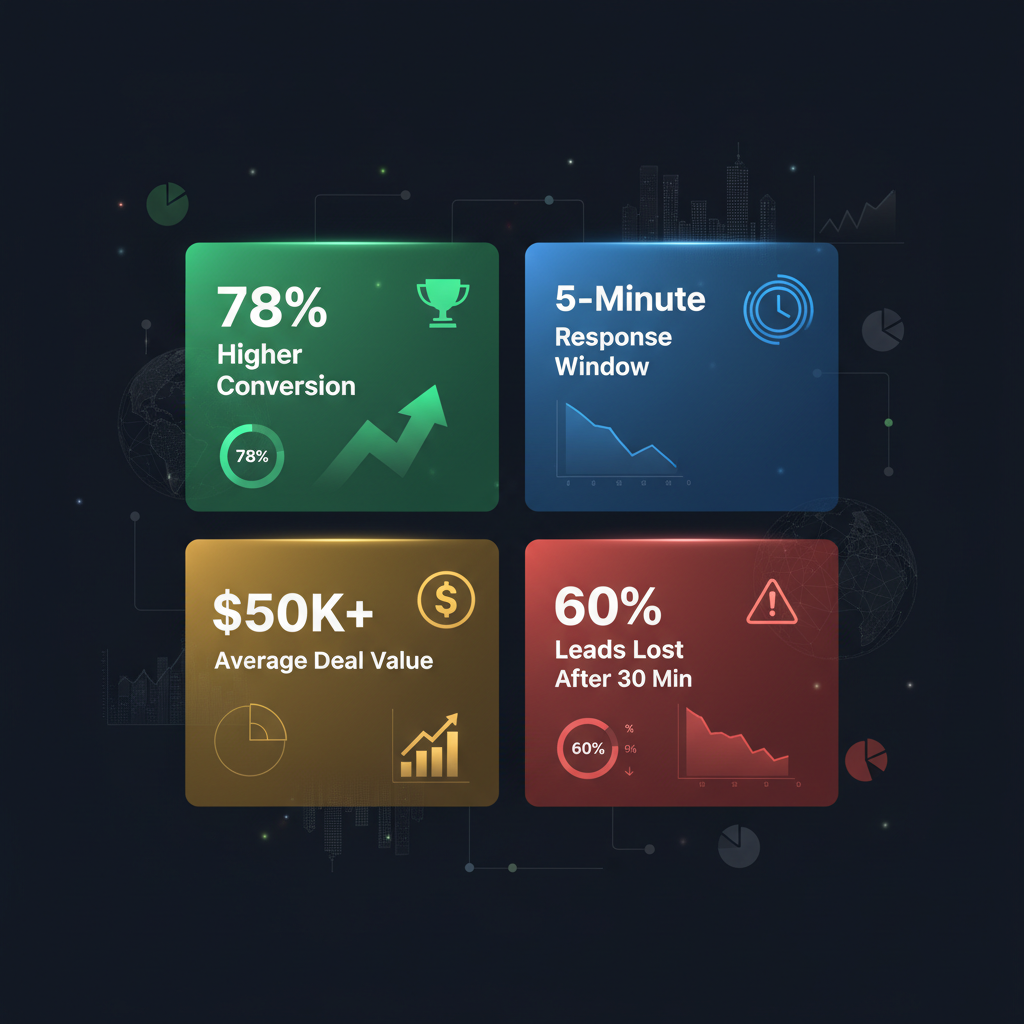
| First responder win rate | 78% | Agent who responds first | NAR 2024 |
| 5-minute response impact | 100x | Higher conversion vs. 30+ min | Harvard Business Review |
| Average agent response time | 39 minutes | Industry average | NAR 2023 |
| Buyer expectation | <1 hour | 82% expect response | Zillow Research |
| AI response time | <30 seconds | Automated systems | AgentiveAIQ |
| Conversion rate improvement | 391% | With 1-minute response | RubixOne |
| Leads lost in 10 minutes | 37% | Due to slow follow-up | Callingly |
The 5-Minute Rule: What Harvard's Analysis of 1.25 Million Leads Reveals
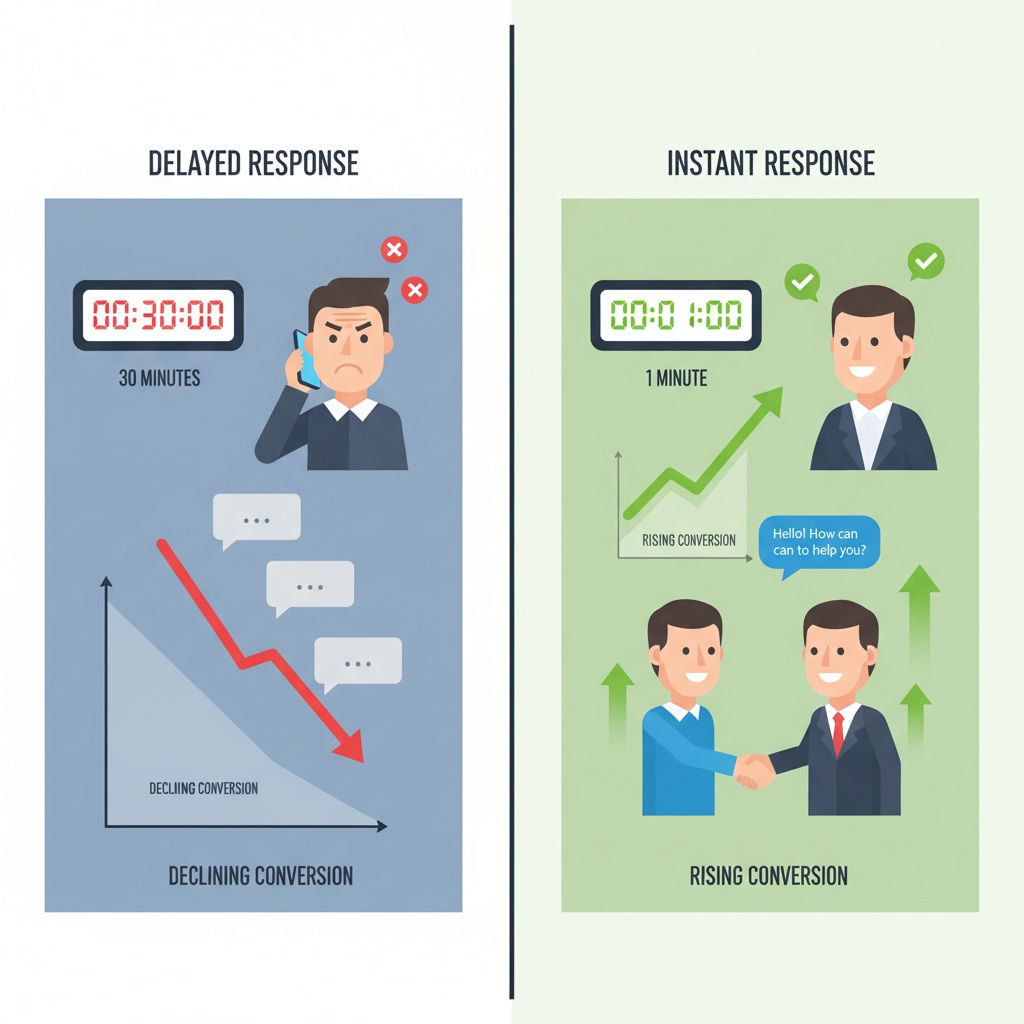
Responding to leads within 5 minutes makes you 100 times more likely to convert
them compared to waiting 30 minutes. This finding from Harvard Business Review's
landmark study of 1.25 million leads fundamentally changed how successful real
estate teams operate.
The data is unforgiving: contact odds drop 100-fold after 30 minutes,
qualification odds plummet 21-fold, and 80% of engagement potential evaporates
after the first 5 minutes. Yet the average real estate agent takes 39 minutes to
respond—leaving massive opportunity on the table.
Why Speed Beats Everything Else
Three psychological factors drive the 5-minute rule:
Intent peaks at inquiry moment - Buyers are most engaged when they submit a
formCompetition is immediate - Multiple agents receive the same lead
simultaneouslyTrust goes to first responder - Quick response signals professionalism and
availability
The first agent to respond wins 78% of the time, regardless of experience level or
brand recognition. Speed literally trumps expertise in initial lead capture.
Current Market Reality: Response Times That Cost Millions
Industry Benchmarks vs. Consumer Expectations
The disconnect is stark:
Consumers expect: <1 hour response (82% of buyers)
Industry delivers: 39-47 hour average response time
Result: 73% of leads never receive contact
This gap represents billions in lost commission annually. A typical agent losing
just 2 deals per month to slow response sacrifices $144,000+ in annual GCI
(assuming $6,000 average commission).
Channel-Specific Conversion Data
Internet lead conversion by response channel:
Email: 3.5% (baseline)
Organic search: 2.2%
Paid search: 2.0%
Phone (immediate): 7-9%
AI-powered instant response: 10-20%
Phone conversion jumps to 61.7% when combining online search with immediate voice
contact. The pattern is clear: faster, more personal responses dramatically
outperform delayed, generic follow-ups.
The AI Automation Solution: From 39 Minutes to 30 Seconds
How Modern Systems Transform Response Economics
AI-powered lead response isn't about replacing agents—it's about capturing leads at
peak interest while agents focus on high-value activities. Current implementations
achieve:
Immediate Impact Metrics:
Response time: <30 seconds (vs. 39-minute average)
24/7 availability: 100% coverage
Lead qualification: Automatic scoring and routing
Cost per lead: 30% reduction
Agent time saved: 10 hours weekly
Real Implementation Results
Texas Brokerage Case Study:
Previous response time: 42 minutes
AI-enabled response: <30 seconds
Result: 41% increase in qualified appointments (6 weeks)
Keller Williams Portland:
Lead reply rate: 92% (vs. 27% industry average)
Agent workload: 40% reduction
Conversion improvement: 41% in 60 days
Phoenix Team (Gated AI Portal):
Pre-qualification: Automatic via conversational AI
Buyer conversion: 44% increase (2 months)
Session duration: 2.3x longer on AI-hosted pages
The 4-Layer Implementation Framework
Layer 1: Instant Acknowledgment (Seconds 0-30)
Automated response confirming receipt
"Thanks for your interest in [property address]"
"I'm checking availability now"
"You'll receive details within 2 minutes"
Layer 2: Intelligent Qualification (Minutes 1-5)
AI-powered conversation gathering:
Timeline and urgency
Budget confirmation
Specific property interests
Preferred communication method
Layer 3: Smart Routing (Minute 5)
Lead assignment based on:
Agent availability and expertise
Geographic specialization
Lead score and priority
Current pipeline capacity
Layer 4: Human Handoff (Minutes 5-15)
Warm transfer with context:
Full conversation history provided
Key qualifying information highlighted
Suggested next actions
Calendar availability shown
Setting Up Your Speed-to-Lead System
Week 1: Foundation
Audit current response times - Measure baseline performance
Map lead sources - Identify all inbound channels
Select automation platform - Choose AI-compatible CRM
Create response templates - Draft instant acknowledgments
Week 2: Automation
Deploy instant response - Activate 30-second acknowledgments
Configure lead scoring - Set qualification criteria
Establish routing rules - Define assignment logic
Test extensively - Submit test leads across all channels
Week 3: Optimization
Analyze performance data - Review response and conversion metrics
Refine messaging - A/B test response templates
Adjust scoring - Calibrate lead qualification
Train team - Ensure smooth human handoffs
Week 4: Scale
Expand channels - Add social media, chat, SMS
Enhance personalization - Implement dynamic content
Add nurture sequences - Build follow-up campaigns
Monitor continuously - Set up performance dashboards
Measuring Success: KPIs That Matter
Primary Metrics
Time to first response: Target <5 minutes (elite: <1 minute)
Contact rate: Target 80%+ (vs. 27% average)
Qualification rate: Target 40%+ of contacted leads
Appointment set rate: Target 30%+ of qualified leads
Show rate: Target 70%+ of set appointments
ROI Calculations
Example calculation (solo agent):
Monthly leads: 100
Current conversion: 2.4% = 2.4 deals
5-minute response conversion: 7% = 7 deals
Additional GCI: $27,600/month ($331,200/year)
AI system cost: $500/month ($6,000/year)
Net ROI: 5,420%
Common Objections Addressed
"AI feels impersonal"
Modern AI maintains brand voice while ensuring no lead waits. 68% of buyers prefer
text/chat for initial contact anyway. AI handles triage; humans handle
relationships.
"My market is different"
The 5-minute rule applies universally. Whether luxury or entry-level, urban or
rural, buyers' psychological response to quick engagement remains constant.
"Too expensive to implement"
Manual response costs more through lost opportunities. One additional deal per
month covers most AI platforms 10x over.
"Technology is complicated"
Modern platforms require zero coding. Setup takes days, not months. Most integrate
with existing CRMs via simple connectors.
Action Steps: Your 30-Day Transformation
Days 1-7: Baseline
Measure current response times
Calculate lost opportunity cost
Research automation platforms
Set performance targets
Days 8-14: Setup
Deploy instant response system
Configure lead routing
Create template library
Train team on new process
Days 15-21: Optimize
A/B test messages
Refine qualification questions
Adjust routing rules
Monitor conversion metrics
Days 22-30: Scale
Add all lead sources
Implement nurture campaigns
Create performance dashboards
Document best practices
The Bottom Line
The 5-minute rule isn't a suggestion—it's a market reality. Every minute of delay
costs conversions, and in today's market with 47-day average DOM and 57% increase
in delistings, you can't afford to lose qualified buyers to faster competitors.
The technology exists. The ROI is proven. The only question is whether you'll
implement before your competition does.
FAQ: Speed-to-Lead Implementation
How much does AI-powered lead response cost?
Entry-level platforms start at $299/month. Enterprise solutions range
$500-2,000/month. ROI typically appears within 30-60 days through improved
conversion alone.
Will AI replace my role as an agent?
No. AI handles initial response and qualification—tasks that waste agent time. You
focus on showings, negotiations, and relationship building where human expertise
matters.
What if leads prefer human interaction?
82% of buyers just want fast response, regardless of source. AI identifies those
preferring immediate human contact and escalates instantly.
How quickly can I implement this?
Basic instant response: 24 hours. Full AI qualification: 1 week. Complete
optimization: 30 days. Most teams see improved metrics within 72 hours of
activation.
Which CRM systems integrate with AI response tools?
Most major platforms (KvCORE, Follow Up Boss, Chime, LionDesk) offer native
integrations. Others connect via Zapier or API. Compatibility is rarely an issue.
Ready to respond in seconds instead of hours? For weekly insights on real estate
automation and lead conversion optimization, visit US Tech Automations or schedule
a speed-to-lead audit.
Tags
About the Author
Specializing in real estate technology and lead conversion optimization
Related Articles
Speed to Lead: The 5-Minute Golden Window That Transforms Real Estate Success
14 min read
The 5-Minute Lead Response Rule That Changes Everything: Why 78% of Real Estate Leads Go to the First Responder
12 min read
AI Lead Nurturing for Real Estate in 2025: Transform 46% More Leads into Closed Deals with Speed-to-Lead Automation
12 min read
See how AI agents fit your team
US Tech Automations builds and runs the AI agents that handle this work end to end, so your team doesn't have to.
View pricing & plans