Do Education Sites Block AI Crawlers? Sealed Data
Education is a sector defined by the wide distribution of knowledge — open courseware, academic papers, language-learning tools, and university research portals. That philosophy appears to extend to AI-crawler access. When US Tech Automations Research checked the robots.txt files of 9 prominent Education sites in June 2026, almost none of them placed any restrictions on AI bots.
Only 1 of 7 Education sites with a parseable robots.txt blocks any AI crawler.
That 14.3% block rate places Education ninth among the 10 categories in this Closing Web edition, second-lowest behind only Government (12.5%). Both numbers sit far below the corpus-wide average of 44.9% (48 of 107 sites). For teams tracking AI-access policy across the web, Education is as open a category as exists in this corpus.
All data in this report comes from a sealed snapshot of public robots.txt files. Nothing is estimated, modeled, or extrapolated. Every figure is a direct verbatim count from the snapshot sealed June 13, 2026 (sha 741353c4304216ee).
What the Education Data Shows
Of the 9 Education sites checked, 7 returned a parseable robots.txt. Two sites — khanacademy.org and udemy.com — returned no robots.txt at all and are excluded from the blocking rate calculation. Of the 7 parseable sites, only 1 blocks any AI crawler.
| Metric | Count |
|---|---|
| Education sites checked | 9 |
| Sites with parseable robots.txt | 7 |
| Sites blocking at least one AI crawler | 1 |
| Block rate | 14.3% |
| Sites with no robots.txt | 2 |
The sole blocker is coursera.org. The 6 non-blockers are edx.org, mit.edu, harvard.edu, stanford.edu, duolingo.com, and scholar.google.com.
1 of 7 Education sites with a parseable robots.txt blocks any AI crawler — coursera.org.
The 2 no-robots sites (khanacademy.org and udemy.com) are excluded from the rate but are worth noting. A missing robots.txt is not the same as an explicit open policy; it is simply an absence of machine-readable guidance.
6 of the 7 Education sites with a parseable robots.txt impose no restrictions on any known AI crawler.
The Sole Blocker: coursera.org
coursera.org is the only Education site in this corpus that restricts any AI crawler. Coursera is a commercial platform that charges for access to courses and certificates; its content is a mix of video lectures, assignments, and graded materials largely gated behind enrollment. The public-facing portion that robots.txt governs — course catalog pages, descriptions, preview content — represents meaningful commercial value.
The decision to block AI crawlers from that catalog is consistent with a paid-access business model. If AI systems can surface Coursera course descriptions, instructor names, and syllabi directly, the incentive for a user to visit Coursera itself and potentially enroll may weaken. The robots.txt choice signals a desire to preserve that discovery funnel.
Coursera also appears in the llms.txt list alongside edx.org, khanacademy.org, and duolingo.com — four Education sites that maintain a voluntary AI-access declaration file in addition to (or alongside) their robots.txt stance. That coursera.org blocks in robots.txt while also maintaining an llms.txt reflects a nuanced posture: restrict automated training crawlers, but engage transparently with AI operators about what the site is.
The Non-Blocker Majority: Universities and Open Platforms
The 6 non-blocking Education sites span academic institutions and open-platform properties. mit.edu, harvard.edu, and stanford.edu are among the most prominent research universities in the world; their public-facing web presence includes course catalogs, research publications, faculty profiles, and news. None of these impose AI-crawler restrictions in their robots.txt.
The permissive posture of academic institutions is consistent with principles of open academic exchange. Universities have long operated on the assumption that knowledge should be widely accessible; extending that to AI-crawler access may feel like a natural continuation rather than a new policy decision. Research institutions also often benefit from AI systems that can surface citations, papers, and faculty profiles — increased discoverability can support the institution.
edx.org, a platform with roots in MIT and Harvard, also returns no AI-crawler blocks. duolingo.com — a language-learning app with a large corpus of pedagogical content — does not restrict AI crawlers in its robots.txt, though it does maintain an llms.txt file. scholar.google.com, which indexes academic literature, similarly imposes no restrictions.
khanacademy.org and udemy.com serve no robots.txt at all, meaning crawlers receive no machine-readable guidance from those domains.
Cross-Category Rankings
Education ranks ninth of 10 categories. Only Government (12.5%) has a lower block rate.
| Category | Sites Checked | With robots.txt | Any Blocker | Block Rate |
|---|---|---|---|---|
| News | 20 | 17 | 14 | 82.4% |
| Tech | 15 | 13 | 9 | 69.2% |
| Entertainment | 9 | 9 | 6 | 66.7% |
| Reference | 14 | 11 | 6 | 54.5% |
| Social | 10 | 10 | 4 | 40% |
| Travel | 9 | 9 | 3 | 33.3% |
| Finance | 12 | 11 | 2 | 18.2% |
| Retail | 15 | 12 | 2 | 16.7% |
| Education | 9 | 7 | 1 | 14.3% |
| Government | 9 | 8 | 1 | 12.5% |
The bottom four categories — Finance (18.2%), Retail (16.7%), Education (14.3%), and Government (12.5%) — all sit well below the corpus average. This cluster contrasts sharply with News at 82.4%, where editorial publishers have broadly moved to restrict AI training access. Education and Government share a structural characteristic: their public-facing content is often designed to be freely accessible, and the mission of the institution may actively support AI discoverability.
The contrast with Entertainment sites at 66.7% is stark. Entertainment properties — streaming services, music platforms, trade press — have strong commercial reasons to control content access. Most Education sites in this corpus have not made that same calculation.
Corpus-Wide Operator Leaderboard (All 107 Sites)
The following counts are corpus-wide — the most-blocked AI operators across all 107 parseable sites in the corpus, not Education-specific.
| AI Operator | Sites Blocking (of 107) |
|---|---|
| Common Crawl | 40 |
| Anthropic | 39 |
| ByteDance | 37 |
| OpenAI | 35 |
| Meta | 35 |
| Apple | 31 |
| Diffbot | 30 |
| Perplexity | 29 |
| Cohere | 27 |
| 25 | |
| Amazon | 22 |
| Mistral | 12 |
Common Crawl leads with 40 blocks across 107 sites. Anthropic follows at 39. These are all-corpus figures. The 12 AI operators tracked range from Common Crawl (40 blocks) to Mistral (12). Education's sole blocker — coursera.org — contributes to these counts but the counts themselves span all categories.
Across 107 sites, Common Crawl is blocked by 40 — the most of any operator.
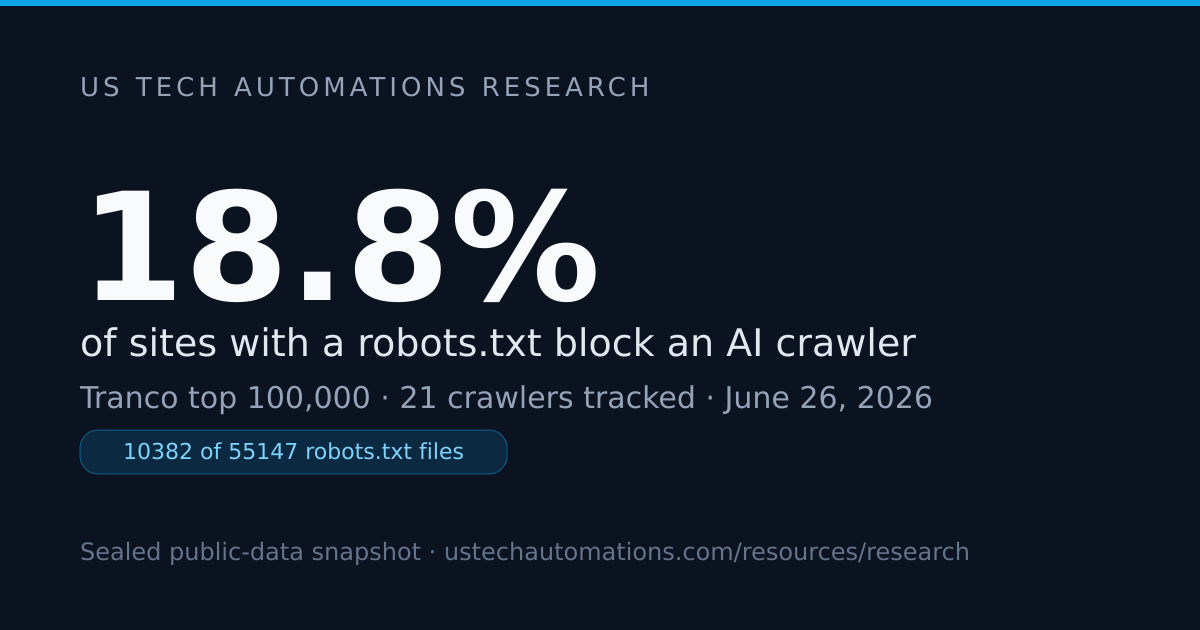
48 of 107 sites corpus-wide block at least one AI crawler — 44.9%.
Education blocks AI crawlers at just 14.3% of sites.
Education at 14.3% sits far below that line. Only Government (12.5%) is more open. Together, Education and Government represent the least-restricting sectors in this corpus.
Methodology
US Tech Automations Research fetched the robots.txt file for each of the 122 sites in the Closing Web corpus on June 13, 2026. Each response was categorized as parseable (returned a parseable robots.txt file with valid syntax), absent, or error. For the 107 parseable responses, we checked for 21 known AI-crawler bot strings across 12 operators. A site is counted as "blocking" if any Disallow directive covers "/" under any AI-crawler user-agent.
The snapshot is point-in-time and sealed — nothing is estimated, modeled, or extrapolated. khanacademy.org and udemy.com are excluded from the blocking rate because they returned no robots.txt — they are included in the "sites checked" count but not the "parseable" denominator. The snapshot is sealed at sha 741353c4304216ee. All figures in this report are verbatim counts from that snapshot.
The llms.txt entries for coursera.org, edx.org, khanacademy.org, and duolingo.com were recorded as a separate boolean and do not affect the robots.txt blocking count.
Who This Is For
This report is relevant for:
SEO and content teams at edtech platforms evaluating whether to follow coursera.org or maintain an open posture
Academic IT teams at universities tracking how peer institutions handle AI-crawler policy
Data teams at AI companies identifying which education properties are open for retrieval or training
Competitive intelligence teams mapping robots.txt posture trends in the education sector
Policy researchers studying how open-access norms in academia interact with AI-access conventions
If your organization tracks robots.txt policy across a watchlist of education domains, manual checks do not scale as policies evolve.
Automating AI-Access Monitoring in Education
Education is currently the second-most-open category in this corpus. That may change. Coursera has already made the choice to block; edtech platforms with similar commercial models may follow. Universities may update their policies as the legal and ethical frameworks around AI training data evolve.
For teams that need to know when any of these sites change their robots.txt, US Tech Automations builds automated workflows that schedule fetches, parse Disallow directives for specific bot strings, and surface changes as alerts. A compliance team at an AI company monitoring whether educational sources remain accessible does not want to find out through a crawl failure — they want proactive notification.
The same automation framework applies across all 10 categories in this corpus. Whether the watchlist is education domains, government sites as tracked here, or finance properties, the underlying workflow is the same: fetch, diff, alert.
Monitoring AI-access policy is not a one-time audit. It is an ongoing operational function that benefits from the same workflow-automation principles applied across content operations, data pipelines, and intelligence workflows.
Key Takeaways
Of 9 Education sites checked, 7 returned a parseable robots.txt. Only 1 of those 7 blocks any AI crawler — a 14.3% rate.
The sole blocker is coursera.org, a commercial edtech platform with a paid-enrollment model.
The 6 non-blockers include mit.edu, harvard.edu, stanford.edu, edx.org, duolingo.com, and scholar.google.com.
khanacademy.org and udemy.com serve no robots.txt at all.
Education ranks 9th of 10 categories — well below the 44.9% corpus-wide average.
coursera.org, edx.org, khanacademy.org, and duolingo.com all maintain an llms.txt file.
Education is the second-most AI-accessible category in this corpus as of June 2026 — only Government is more open.
FAQ
Q: Why does coursera.org block AI crawlers when universities like mit.edu and harvard.edu do not?
A: The sealed data records the policy, not the stated reason. What the data shows is a structural difference: coursera.org is a commercial platform that charges for course access, while MIT and Harvard publish their public web presence under open-access norms typical of academic institutions. Sites with paid-enrollment models have more commercial incentive to restrict AI access to catalog content that drives their discovery funnel.
Q: What does it mean that khanacademy.org and udemy.com have no robots.txt?
A: A missing robots.txt means crawlers receive no machine-readable guidance from those domains. Compliant crawlers typically treat a missing file as "no restrictions stated" and crawl freely. These 2 sites are not counted in the blocking rate denominator because the denominator requires a parseable file to exist.
Q: Does blocking in robots.txt actually prevent AI crawlers from accessing a site?
A: No. robots.txt is an honor-system protocol — compliant crawlers respect it, but the file provides no technical enforcement. Authentication walls, rate limits, and IP blocks provide actual access control. robots.txt blocking is a policy signal to compliant operators, not a technical barrier.
Q: Why do so many Education sites maintain an llms.txt but still not block?
A: llms.txt is a voluntary convention for communicating AI-access preferences in a structured way. Maintaining an llms.txt file does not imply restriction — it may equally reflect an open posture described in a machine-readable format. coursera.org blocks in robots.txt and maintains llms.txt. edx.org, khanacademy.org, and duolingo.com maintain llms.txt without any robots.txt blocking. The two signals are independent.
Q: How does Education compare to Finance in this corpus?
A: Both are low-blocking categories. Finance sits at 18.2% (2 of 11 parseable sites blocking), and Education at 14.3% (1 of 7 blocking). The Finance report shows that the Finance blockers — nerdwallet.com and fool.com — are also commercial editorial properties. The pattern across both categories is the same: commercial content-first platforms are more likely to restrict; institutions and transactional platforms are not.
This snapshot of Education sites is one slice of a wider dataset; read how many top websites block AI crawlers for the cross-industry view.
Source: US Tech Automations Research — Closing Web edition; figures are verbatim counts from public robots.txt files sealed June 13, 2026 (snapshot sha 741353c4304216ee).
Get this data as a daily feed
The numbers in this report come from a permit feed we monitor daily. Leave your email and we will follow up about a daily feed for your ZIPs and categories.
Prefer to talk first? Contact us.
Cite this report
US Tech Automations Research, 2026-06 edition. “Do Education Sites Block AI Crawlers? Sealed Data.” https://ustechautomations.com/resources/blog/do-education-sites-block-ai-crawlers-2026
Sealed snapshot sha256: 741353c4304216ee
Machine-readable data: CSV · JSON · All research & methodology
About the Author

Helping businesses leverage automation for operational efficiency.