22.2 GW of Power Is Queued in Minnesota
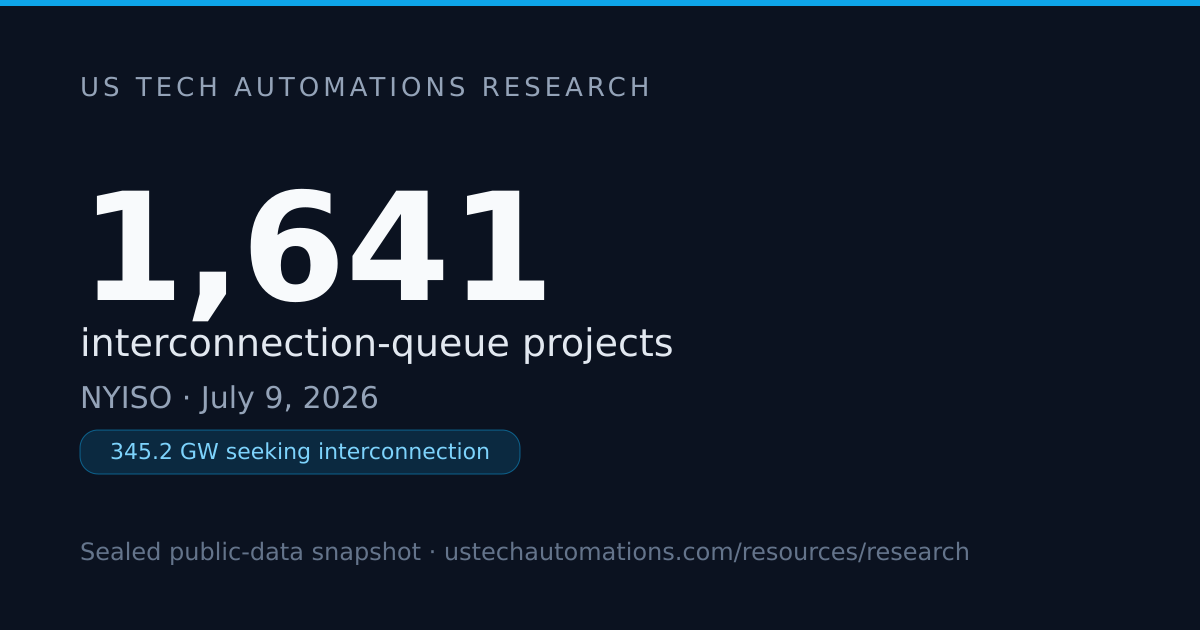
Minnesota's interconnection queue held 22.2 GW of requested capacity across 277 projects on June 11, 2026, according to our sealed grid-queue snapshot. Placed against the 1600.7 GW national total across all covered ISOs, Minnesota's queue is a measured contributor — smaller than neighboring Illinois (50.6 GW) or Indiana (39.1 GW), but with a status distribution that carries a notable signal: 56.3% of Minnesota's projects show as withdrawn.
A queue position is a request to connect, NOT a built, approved, or financed project. The withdrawal rate reinforces this. Of all 277 projects in Minnesota's MISO-linked history, 156 — a majority — have been marked withdrawn. Only 120 remain still-in-queue and 1 shows operational status. The queue represents developer interest over time, not a delivery pipeline.
This report covers generation and storage projects sitting in the interconnection queues of the U.S. grid operators (ISOs and RTOs) that publish a machine-readable queue, as captured by US Tech Automations' sealed daily grid snapshots. This is a census of the published queues, not of every project on every grid in the country.
How Minnesota Compares to Its MISO Neighbors
Putting Minnesota's figures directly against its nearest peers clarifies its relative position. The comparison table below uses sealed values from the research desk's June 11, 2026 snapshot. All figures are from the display set; no values have been computed or combined.
| State | Projects | Capacity (GW) | Withdrawn (%) | Dominant Fuel | Primary ISO |
|---|---|---|---|---|---|
| Illinois | 482 | 50.6 GW | — | Solar | MISO |
| Indiana | 456 | 39.1 GW | — | Solar | MISO |
| Arkansas | 413 | 32.9 GW | — | Solar | MISO |
| Missouri | 178 | 24.8 GW | — | Solar | MISO |
| Minnesota | 277 | 22.2 GW | 56.3% | Solar | MISO |
| Iowa | 228 | 20.3 GW | 49.6% | Wind | MISO |
| Mississippi | 202 | 9.9 GW | — | Solar | MISO |
Minnesota's 277 projects at 22.2 GW sit in the middle of its MISO peer band. Iowa, a state with comparable project count, shows Wind as its dominant fuel — while Minnesota leads on Solar. The 56.3% withdrawal rate is among the highest in this group for states where the withdrawal figure is available in the display set.
MISO as a whole carries 3,786 projects at 299.6 GW, with a withdrawal rate of 56.2%. Minnesota's 56.3% closely mirrors MISO's own withdrawal rate — meaning Minnesota is not an outlier in its ISO; it is behaving like a typical MISO participant. The MISO interconnection queue report covers the broader regional picture Minnesota sits within.
22.2 GW of projects are queued in Minnesota as of June 11, 2026.
156 of Minnesota's 277 projects — 56.3% — show as withdrawn.
Solar leads Minnesota's queue at 44.4% of filed projects.
Key Findings
277 projects hold 22.2 GW of requested capacity in Minnesota's interconnection queue, per the sealed snapshot
Solar leads at 44.4% of project share, with 123 Solar projects totaling 9,811 MW
56.3% of projects — 156 — have withdrawn, mirroring MISO's own 56.2% withdrawal rate
120 projects remain still-in-queue, while only 1 shows operational status
The median project size is 150 MW, matching the national median exactly
The largest project is Lyon County - Cedar Mountain 345 kV Line Tap at 600 MW
Minnesota's Queue at a Glance
| Metric | Value |
|---|---|
| Total projects | 277 |
| Total capacity (MW) | 22,160 MW |
| Total capacity (GW) | 22.2 GW |
| Median project size | 150 MW |
| Still-in-queue | 120 (43.3%) |
| Withdrawn | 156 (56.3%) |
| Operational | 1 |
| Largest project | Lyon County - Cedar Mountain 345 kV Line Tap (600 MW) |
| Primary ISO | MISO |
| Snapshot date | June 11, 2026 |
The median of 150 MW — exactly at the national median — tells an interpretive story: Minnesota's queue is not skewed toward either very large or very small projects. The distribution is reasonably balanced around the midpoint that characterizes most of MISO's queue. That contrasts with MISO's smallest projects in dense urban markets (Illinois and Michigan produce many small Solar entries) and SPP's heavier per-project averages.
Minnesota's withdrawal rate of 56.3% is nearly identical to MISO's system-wide 56.2%. This is not a dysfunction of Minnesota's market — it reflects MISO's queue process, in which developers often file multiple projects speculatively before selecting which to advance.
The Fuel Mix: Solar Leads, Wind Third
Minnesota's queue is Solar-led but with meaningful Wind and Battery Storage participation — a pattern that differs from pure-Solar states like Illinois, and from Wind-first states like Iowa and Oklahoma.
| Fuel | Projects | Capacity (MW) |
|---|---|---|
| Solar | 123 | 9,811 MW |
| Battery Storage | 69 | 4,480 MW |
| Wind | 65 | 6,186 MW |
| Hybrid | 13 | 1,618 MW |
| Natural Gas | 3 | 61 MW |
| Hydro | 3 | 4 MW |
| Other | 1 | 0 MW |
Wind's 65 projects carrying 6,186 MW is noteworthy: Wind is third by project count but accounts for a substantial share of total capacity because individual Wind projects are typically larger than Solar arrays. Wind at 6,186 MW vs Solar at 9,811 MW, despite Wind having roughly half as many projects, illustrates the size asymmetry.
Battery Storage at 69 projects and 4,480 MW is the largest secondary category by project count. Storage co-located with Solar is a common filing pattern — developers stack both technologies at the same interconnection point to maximize dispatch revenue and reduce per-MW interconnection costs.
The 3 Natural Gas projects totaling only 61 MW are a striking contrast to Oklahoma's 21 Natural Gas projects at 9,058 MW. Minnesota's gas queue is minimal, both in count and in capacity.
Wind carries 6,186 MW across just 65 projects, while Solar holds 9,811 MW across 123. The size asymmetry — larger Wind filings, more numerous Solar arrays — is the defining feature of Minnesota's fuel mix.
How Minnesota Fits the National Picture
| State / ISO | Projects | Capacity (GW) | Dominant Fuel |
|---|---|---|---|
| California (CA) | 2,076 | 416.8 GW | Solar |
| Texas (TX) | 2,029 | 453.7 GW | Battery Storage |
| Massachusetts (MA) | 605 | 81.3 GW | Solar |
| Michigan (MI) | 502 | 44.7 GW | Solar |
| Illinois (IL) | 482 | 50.6 GW | Solar |
| Indiana (IN) | 456 | 39.1 GW | Solar |
| Oklahoma (OK) | 306 | 57.7 GW | Wind |
| Minnesota (MN) | 277 | 22.2 GW | Solar |
| Wisconsin (WI) | 233 | 27.1 GW | Solar |
| Iowa (IA) | 228 | 20.3 GW | Wind |
Minnesota sits between Wisconsin and Iowa in project count. Its 22.2 GW is modestly higher than Wisconsin's 27.1 GW — wait, Wisconsin is higher at 27.1 GW despite fewer projects. That signals Wisconsin's projects carry higher average capacity per filing. Minnesota's 22.2 GW from 277 projects averages out below 100 MW per project when withdrawn entries are factored into the denominator — consistent with a queue that includes many smaller Solar filings that ultimately withdrew.
The national queue spans 10,618 projects and 1600.7 GW across 5 ISOs and 28 states. Minnesota's contribution is proportional to its position as a mid-size MISO participant, neither dominant nor marginal.
Methodology and Scope
Source: Public ISO/RTO interconnection-queue listings, via our grid-queue clock (sealed daily, content-hashed).
Honesty statement: All figures are computed directly from US Tech Automations' sealed daily grid-queue snapshots; nothing is estimated, modeled, or extrapolated. Fuel and status labels are grouped from each ISO's own categories, and the grouping rules appear in the display set.
Fuel bucketing: Vendor fuel and technology labels differ by ISO and are grouped into Solar, Battery Storage, Wind, Natural Gas, Hybrid and Other by keyword.
Status bucketing: Each ISO publishes its own status taxonomy; statuses are grouped into withdrawn, operational (explicitly in-service or commercial operation), still-in-queue, and unknown for feeds that publish no status. Some ISOs drop withdrawn projects from their feed entirely.
The grid disclaimer: A queue position is a request to connect, not a built, approved, or financed project. Interconnection queues are aspirational. A large share of projects withdraw before construction.
How the research desk seals this data:
Collect. Each supported ISO feed is fetched daily from its published machine-readable listing.
Normalize. Fuel and status labels are standardized across ISOs using keyword bucketing.
Seal. The normalized day's data is content-hashed (SHA) and recorded in an append-only log.
Aggregate. State- and ISO-level display values are computed from the sealed records.
This snapshot covers 5 ISOs and 28 states as of June 11, 2026.
Frequently Asked Questions
Q: Does a 56.3% withdrawal rate mean Minnesota's grid is unusually difficult to interconnect to?
A: Not necessarily. MISO's own system-wide withdrawal rate is 56.2% — Minnesota is tracking almost exactly with its ISO. Withdrawal rates this high are common in ISOs where the queue is congested and developers file multiple applications speculatively, withdrawing the ones that do not clear cost studies favorably.
Q: What does the Lyon County - Cedar Mountain 345 kV Line Tap represent?
A: This is the single largest project in Minnesota's queue at 600 MW. The name indicates a transmission-side filing — a line tap onto an existing 345 kV transmission segment in Lyon County, a county in southwestern Minnesota with significant wind development. The project's fuel classification would depend on what generation or storage technology connects through that tap point.
Q: Are these 277 projects all in MISO?
A: The display set records MISO as the primary ISO for Minnesota, and 275 of the state's projects route through MISO. This is a census of covered ISOs only; projects connecting to utilities or cooperatives outside covered ISO footprints do not appear here.
Q: Why does the "still-in-queue" percentage look low relative to total projects?
A: Minnesota shows 120 still-in-queue out of 277 total — about 43.3%. The remaining majority has withdrawn. This is expected: MISO's queue process is multi-year, and the snapshot captures the full history of filings in MISO's published data, not just recent applicants.
Putting Queue Data to Work
Energy project developers, equipment suppliers, and power buyers use Minnesota queue data in distinct ways. For national-level context across every covered ISO, see the USTA Interconnection Queue Index.
Developers siting the next Minnesota project compare the Solar-heavy existing queue to available transmission capacity in specific counties. A queue dense with Solar filings in a given area signals potential congestion on shared interconnection lines — a cost signal worth modeling before filing.
Equipment suppliers and EPC contractors read the 65 Wind projects at 6,186 MW as a forward indicator of turbine and balance-of-plant demand in Minnesota and nearby MISO territory. Suppliers who track which projects move through feasibility studies can prioritize sales conversations accordingly.
Corporate energy buyers seeking Solar PPAs in Minnesota can identify which projects are still-in-queue and at what capacity, narrowing outreach to developers with active filings. The 120 still-in-queue projects represent the pool from which near-term PPA conversations might emerge.
US Tech Automations automates queue monitoring — ingesting daily feed changes, flagging status shifts, and routing signals to the right team. Teams that track this manually can route that work to an automated pipeline instead. The solar interconnection queue technology report covers Minnesota's Solar-first fuel profile in more detail.
Automate your queue-monitoring workflow at /platform/agentic-workflows.
Source: US Tech Automations Research — computed from the sealed daily interconnection-queue snapshot, June 11, 2026.
Get this data as a daily feed
The numbers in this report come from a permit feed we monitor daily. Leave your email and we will follow up about a daily feed for your ZIPs and categories.
Prefer to talk first? Contact us.
Cite this report
US Tech Automations Research, 2026-06 edition. “22.2 GW of Power Is Queued in Minnesota.” https://ustechautomations.com/resources/blog/minnesota-interconnection-queue
Sealed snapshot sha256: 4938600b6a99772e
Machine-readable data: CSV · JSON · All research & methodology