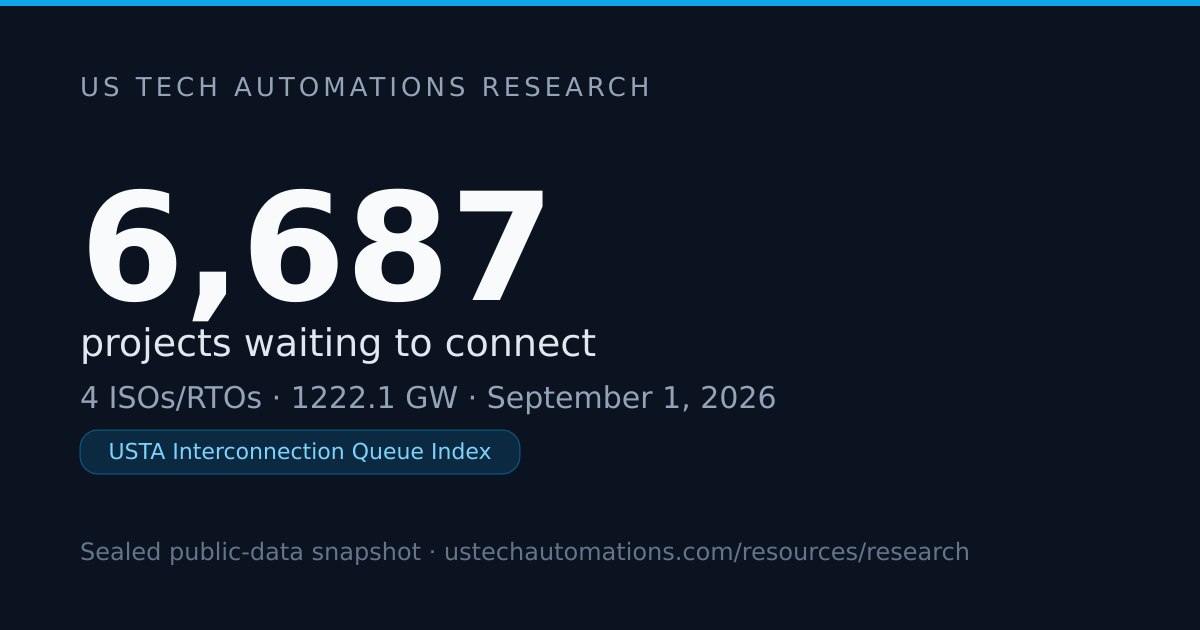
1600.7 GW in the U.S. Interconnection Queue
There is 1600.7 GW of generation and storage sitting in U.S. interconnection queues across 5 ISOs and RTOs on the sealed snapshot of June 11, 2026 — spread over 10,618 separate project requests. This is the launch census of the US Tech Automations Interconnection Queue Index, a daily-sealed count of every power project that has applied to connect to the grid through an operator that publishes a machine-readable queue.
One number sets the tone for the whole index: of those 10,618 requests, 3,877 — a 36.5% share — are already withdrawn. A queue position is a request to connect, not a built, approved, or financed project, and interconnection queues are aspirational by design. This is the first edition, a single sealed day, so there are no trends here yet — only a census. Read it as a snapshot of intent across the grid, not a forecast of supply.
The index counts 1600.7 GW and 10,618 projects across 5 grid operators.
This is a census of the published queues, not of every project on every grid in the country. Generation and storage projects sitting in the interconnection queues of the U.S. grid operators (ISOs and RTOs) that publish a machine-readable queue, as captured by the sealed daily grid snapshots, are the entire scope. Coverage is the operators that publish queues, not every U.S. utility — many regions run their own processes outside these 5 feeds and are not counted here.
Frequently Asked Questions
Q: What is an interconnection queue?
A: It is the line every power project waits in to connect to the high-voltage grid. A developer files a request, the operator studies the grid impact, and the project either advances, withdraws, or stalls. This index counts the requests in those lines across 5 operators on one sealed day.
Q: Does 1600.7 GW mean 1600.7 GW will be built?
A: No. A queue position is a request to connect, not a built, approved, or financed project. Already 36.5% of projects are withdrawn, and many that remain will never reach construction. The 1600.7 GW is requested capacity — a measure of intent, not a build forecast.
Q: Why only 5 operators and 28 states?
A: Coverage is the operators that publish a machine-readable queue, not every U.S. utility. The index spans 5 ISOs and RTOs touching 28 states. Regions served by vertically integrated utilities outside these feeds run separate processes and are not in this census.
Q: How is a sealed snapshot different from a live ISO website?
A: Live operator pages change as projects enter and leave. This index is content-hashed and frozen on June 11, 2026, so the figures are fixed and reproducible. A re-query later would return different numbers; this edition will not.
Q: When will the index show trends?
A: Not yet. This is the launch edition — one sealed day. Trend claims need multiple monthly observations, and we will not make them until the clock holds several editions. Today the index is a census, nothing more.
Q: Who uses an index like this?
A: Project developers siting the next request, EPC contractors and equipment suppliers reading demand, utilities and policy researchers, and energy buyers seeking PPAs. Each reads the same sealed numbers for a different decision.
The Index at a Glance
The national totals frame everything in the index. The status split is the honesty layer.
| National metric | Value |
|---|---|
| Projects | 10,618 |
| Requested capacity | 1600.7 GW |
| Median project size | 150 MW |
| Withdrawn | 3,877 (36.5%) |
| Still in queue | 4,699 (44.3%) |
| Operational | 290 |
| Unknown | 1,752 (16.5%) |
| Largest project | ATLAS COMPLEX |
| Largest project size | 3,200 MW |
| Top operator | MISO |
Almost half of all requests — 4,699, or 44.3% — are still active in the queue, while 3,877 (36.5%) are withdrawn. Only 290 read as operational. The 1,752 in the unknown bucket (16.5%) come from feeds that publish no status; do not read them as active. Among projects with a known status, 43.7% are withdrawn — the cleanest single read on how thin an average queue position is.
The withdrawn-of-known figure is the one to carry away from this census. Whole-population percentages are dragged down by the unknown bucket, which mixes genuinely-pending projects with already-resolved ones the feeds simply do not label. Restricting the denominator to projects whose status we can actually read gives the honest churn rate: 43.7%. Read against the headline 1600.7 GW, it is the reason no one should treat the queue total as a build pipeline. The queue is where ambition is registered; only a minority of it survives the studies, the financing, and the offtake hunt that follow.
Across the index, 3,877 projects (36.5%) are already withdrawn.
The Fuel Mix Nationwide
Renewables and storage dominate the national pipeline; the legacy thermal and baseload technologies are a thin tail.
| Technology | Projects | Requested capacity |
|---|---|---|
| Solar | 4,145 | 515,078 MW |
| Battery Storage | 2,824 | 441,992 MW |
| Wind | 1,722 | 319,172 MW |
| Other | 865 | 82,156 MW |
| Natural Gas | 522 | 177,488 MW |
| Hybrid | 483 | 54,229 MW |
| Hydro | 24 | 5,086 MW |
| Nuclear | 24 | 2,374 MW |
| Coal | 9 | 3,115 MW |
Solar is the top fuel nationwide at a 39.0% share, with 4,145 projects. Battery Storage and Wind follow. The thermal and baseload categories barely register on count: Natural Gas at 522, and Hydro, Nuclear, and Coal in the low dozens or single digits. Coal shows just 9 entries — a measure of how little new coal is even being requested.
Solar leads the national fuel mix at a 39.0% share of all projects.
The Operator Leaderboard
Five operators carry the entire index. MISO leads on count; CAISO leads on capacity.
| Operator | Projects | Capacity | Median | Top fuel |
|---|---|---|---|---|
| MISO | 3,786 | 299.6 GW | 150 MW | Solar |
| CAISO | 2,278 | 492.2 GW | 128 MW | Solar |
| ERCOT | 1,839 | 426.8 GW | 201 MW | Battery Storage |
| ISO-NE | 1,752 | 193.1 GW | 26 MW | Other |
| SPP | 963 | 188.9 GW | 173 MW | Wind |
MISO posts the most projects at 3,786 and runs Solar as its top fuel. CAISO, with fewer projects (2,278), carries more requested capacity at 492.2 GW — California's queue skews toward larger units. ERCOT leads with Battery Storage at a 50.1% share, while SPP is the wind operator. ISO-NE's tiny 26 MW median reflects a queue full of smaller New England projects.
The operator reports go deeper. See the MISO interconnection queue report for the largest pool by count and the CAISO interconnection queue report for the largest by capacity.
The State Leaderboard
Across the 28 states touched by these operators, two stand far ahead.
| State | Projects | Capacity | Top fuel |
|---|---|---|---|
| Texas | 2,029 | 453.7 GW | Battery Storage |
| California | 2,076 | 416.8 GW | Solar |
| Massachusetts | 605 | 81.3 GW | Solar |
| Michigan | 502 | 44.7 GW | Solar |
| Illinois | 482 | 50.6 GW | Solar |
| Indiana | 456 | 39.1 GW | Solar |
| Arkansas | 413 | 32.9 GW | Solar |
| Maine | 409 | 37.0 GW | Solar |
| Louisiana | 392 | 23.7 GW | Solar |
| Connecticut | 323 | 38.9 GW | Other |
California leads on project count with 2,076, and Texas leads on capacity at 453.7 GW — the two states alone carry a large fraction of the index. Solar is the top fuel in most leaderboard states; Texas is the storage exception. The California interconnection queue and Texas interconnection queue reports cover the two leaders.
The Massachusetts interconnection queue view rounds out the New England picture, where the median project runs far smaller than in the Texas or California fields.
The Technology Leaderboard
The same fuel mix, read as a ranking with the busiest operator for each.
| Technology | Projects | Capacity | Withdrawn | Top operator |
|---|---|---|---|---|
| Solar | 4,145 | 515.1 GW | 45.1% | MISO |
| Battery Storage | 2,824 | 442.0 GW | 32.6% | ERCOT |
| Wind | 1,722 | 319.2 GW | 38.8% | MISO |
| Natural Gas | 522 | 177.5 GW | 24.1% | ISO-NE |
| Hybrid | 483 | 54.2 GW | 48.4% | MISO |
Solar leads the ranking but churns hard at a 45.1% withdrawal rate; Hybrid churns hardest at 48.4%. Natural Gas, the smallest major by count, is steadiest at 24.1% withdrawn. The technology reports drill into each: the solar interconnection queue leads the field by both count and capacity.
The complements fill in behind it. The battery storage interconnection queue report covers the second-largest technology, and the wind interconnection queue report covers the third.
Methodology
Source: Public ISO/RTO interconnection-queue listings, via the US Tech Automations grid-queue clock (sealed daily, content-hashed).
All figures are computed directly from US Tech Automations' sealed daily grid-queue snapshots; nothing is estimated, modeled, or extrapolated. Fuel and status labels are grouped from each ISO's own categories, and the grouping rules appear in the display set.
Coverage is the key caveat: the index counts the operators that publish a machine-readable queue, not every U.S. utility. It spans 5 ISOs and RTOs touching 28 states. Whole regions run interconnection through vertically integrated utilities outside these feeds and are not in this census — the index is a measure of the published queues, no more.
The grid disclaimer applies throughout: a queue position is a request to connect, not a built, approved, or financed project. A large share withdraw before construction, so 1600.7 GW is requested capacity, never a build forecast.
Two grouping rules govern the buckets. Vendor fuel and technology labels differ by ISO and are grouped into Solar, Battery Storage, Wind, Natural Gas, Hybrid and Other by keyword. Each ISO publishes its own status taxonomy; statuses are grouped into withdrawn, operational (explicitly in-service or commercial operation), still-in-queue, and unknown for feeds that publish no status. Some ISOs drop withdrawn projects from their feed entirely — so an operator showing no withdrawals is a feed artifact, not a claim that none withdrew.
How the clock seals an edition:
Collect each covered ISO/RTO queue feed on the snapshot day, June 11, 2026.
Normalize labels so every vendor fuel string maps into the shared technology buckets.
Bucket status for each project as withdrawn, operational, still-in-queue, or unknown.
Seal. Content-hash the day's aggregate so the index is frozen, append-only, and reproducible.
Because this is the launch edition, there are no change claims. The index will not report trends until the clock holds multiple monthly observations.
Put Grid Data to Work
This index fits several readers. Project developers can use the operator and state leaderboards — MISO's 3,786 projects, Texas at 453.7 GW — to see where the next request lands in a crowded field, weighed against the 36.5% national withdrawal rate. EPC contractors and equipment suppliers can read 1600.7 GW of requested capacity, and the fuel mix beneath it, as a national demand map for panels, turbines, and batteries. Utilities and policy researchers get a reproducible baseline; energy buyers chasing PPAs can find where active capacity concentrates.
US Tech Automations builds the automation layer that turns a sealed feed into action: watching queue changes daily, routing each status move to the right desk, and drafting first-touch outreach. The same sealed-snapshot discipline runs the permits research at https://permits.ustechautomations.com.
See how agentic workflows automate queue monitoring
Source: US Tech Automations Research — computed from the sealed daily interconnection-queue snapshot, June 11, 2026.
Get this data as a daily feed
The numbers in this report come from a permit feed we monitor daily. Leave your email and we will follow up about a daily feed for your ZIPs and categories.
Prefer to talk first? Contact us.
Cite this report
US Tech Automations Research, 2026-06 edition. “1600.7 GW in the U.S. Interconnection Queue.” https://ustechautomations.com/resources/blog/us-interconnection-queue-index-june-2026
Sealed snapshot sha256: 4938600b6a99772e
Machine-readable data: CSV · JSON · All research & methodology
About the Author

Helping businesses leverage automation for operational efficiency.