Nebraska Interconnection Queue: 124 Projects
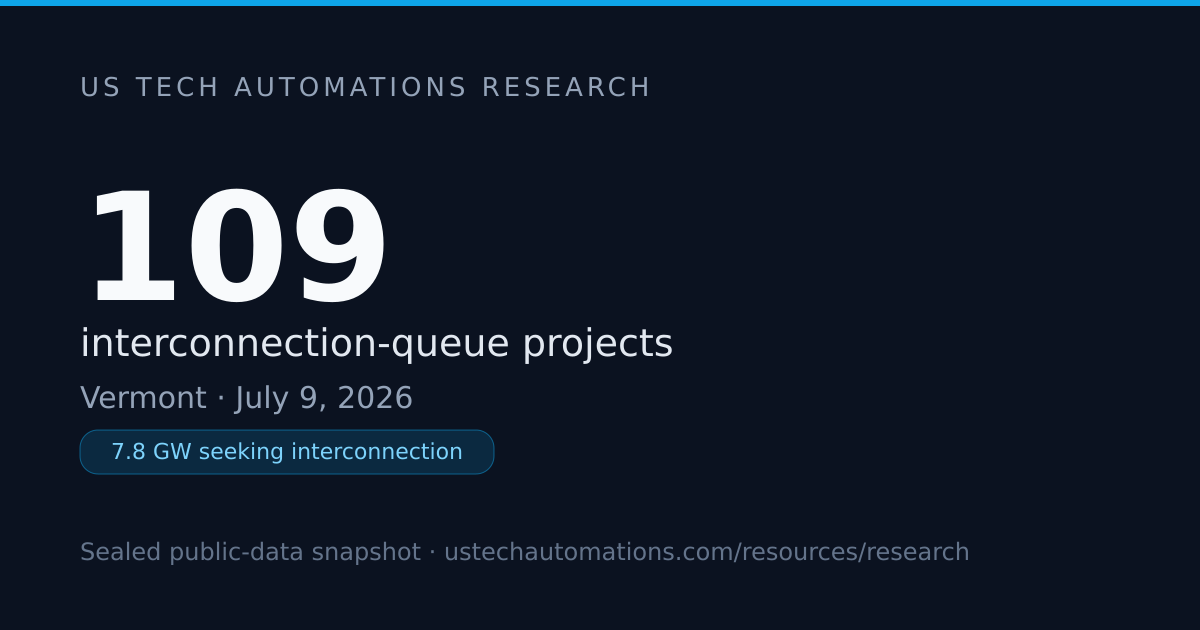
Nebraska sits in wind country — and the state's grid queue reflects that. As of June 11, 2026, 124 projects with 20.5 GW of proposed generation capacity are recorded in U.S. interconnection queues at their Nebraska point of connection, according to the sealed grid-queue snapshot from our grid-queue clock.
Wind leads the fuel mix with 40 projects and 5,651 MW of capacity. That makes Nebraska one of the more distinctive state slates in the national picture: while Solar dominates across most of the country at 39.0% of all projects, Nebraska's queue tips toward Wind at 32.3% of its project count. Before reading the data further, one essential caveat: a queue position is a request to connect, not a built, approved, or financed project. Many projects will withdraw before construction. The 124 projects here represent aspirations, not outcomes.
This report covers generation and storage projects sitting in the interconnection queues of the U.S. grid operators (ISOs and RTOs) that publish a machine-readable queue, as captured by US Tech Automations' sealed daily grid snapshots. This is a census of the published queues, not of every project on every grid in the country.
Key Findings
Nebraska: 124 projects, 20.5 GW queued capacity as of June 11, 2026, per the sealed interconnection-queue snapshot.
Wind leads with 40 projects and 5,651 MW, making it the top fuel type by project count at 32.3% of Nebraska's queue.
62.9% of Nebraska projects (78) are still-in-queue, meaning they hold an active position in the interconnection study process.
46 projects have reached operational status as recorded in the ISO feed — this reflects ISO-published data, not an independent survey.
0.0% withdrawn in this feed — but this is a feed artifact, not a guarantee (see Methodology).
SPP is Nebraska's primary ISO, covering 124 of the state's 124 projects.
Nebraska's Queue at a Glance
The state's queue is anchored by a 700 MW project at the top end, with a median project size of 143 MW — right in line with the national median of 150 MW. That suggests a standard-sized development mix, neither tilted toward micro-scale distributed resources nor dominated by outsized utility-scale projects.
| Metric | Nebraska |
|---|---|
| Total projects | 124 |
| Total capacity | 20,488 MW |
| Capacity (GW) | 20.5 GW |
| Median project size | 143 MW |
| Largest project | 700 MW |
| Still-in-queue | 78 (62.9%) |
| Operational | 46 |
| Withdrawn | 0 (0.0%) |
| Primary ISO | SPP |
The withdrawn count of 0 and withdrawn percentage of 0.0% is a notable figure, but it requires interpretation. SPP does not include withdrawn projects in its published queue feed. This means 0.0% is a data artifact — it does not indicate that no Nebraska projects have ever withdrawn. It reflects the fact that SPP drops withdrawn entries from its listing. Anyone reading this data for forecasting purposes should hold that caveat clearly.
A queue position is a request to connect, not a built, approved, or financed project. Interconnection queues are aspirational: a large share of projects withdraw before construction. The 0.0% withdrawn figure for Nebraska is a feed artifact — SPP drops withdrawn projects from its published listing.
The Fuel Mix in Nebraska's Queue
Nebraska's fuel distribution is one of the more distinctive features of this state's queue. Across the national queue, Solar holds 39.0% of all projects. Nebraska flips that convention: Wind carries the largest project count here, with 40 projects across 5,651 MW. Solar is present but secondary, with 20 projects and 3,618 MW.
| Fuel Type | Projects | Capacity (MW) |
|---|---|---|
| Wind | 40 | 5,651 MW |
| Solar | 20 | 3,618 MW |
| Battery Storage | 19 | 2,677 MW |
| Other | 16 | 3,170 MW |
| Natural Gas | 14 | 3,046 MW |
| Hybrid | 6 | 1,415 MW |
| Hydro | 4 | 17 MW |
| Nuclear | 3 | 120 MW |
| Coal | 2 | 775 MW |
Wind at 32.3% of project count tells a straightforward story: Nebraska's open plains and existing transmission corridors have attracted wind development. Battery Storage at 19 projects and 2,677 MW is also notable — storage at that volume suggests developers see value in pairing it with the state's renewable resources, likely for grid stabilization or peak-shifting.
The Natural Gas count (14 projects, 3,046 MW) is meaningful in a state that has historically relied on dispatchable thermal generation. That capacity signals continued developer interest in gas-fired resources, even as renewable applications dominate by project count.
Wind at 40 projects and 5,651 MW leads Nebraska's queue — a reversal of the national pattern where Solar holds the largest share at 39.0% of all projects across the covered ISOs.
How Nebraska Compares Across Covered States
Nebraska's 124 projects and 20.5 GW position it well below the highest-volume states. California holds 2,076 projects and 416.8 GW; Texas holds 2,029 projects and 453.7 GW. But raw scale comparisons across states are only marginally useful: project volume reflects land area, grid topology, and ISO coverage, not inherent developer preference. Nebraska's 143 MW median project size actually exceeds California's 128 MW median, pointing to a larger-average-project queue.
| State | Projects | Capacity (GW) | Top Fuel | Primary ISO |
|---|---|---|---|---|
| California | 2,076 | 416.8 GW | Solar | CAISO |
| Texas | 2,029 | 453.7 GW | Battery Storage | ERCOT |
| Massachusetts | 605 | 81.3 GW | Solar | ISO-NE |
| Michigan | 502 | 44.7 GW | Solar | MISO |
| Illinois | 482 | 50.6 GW | Solar | MISO |
| Indiana | 456 | 39.1 GW | Solar | MISO |
| Arkansas | 413 | 32.9 GW | Solar | MISO |
| Maine | 409 | 37.0 GW | Solar | ISO-NE |
| Oklahoma | 306 | 57.7 GW | Wind | SPP |
| Nebraska | 124 | 20.5 GW | Wind | SPP |
Nebraska and Oklahoma are the two Wind-dominant states visible in this peer list. Oklahoma holds 306 projects and 57.7 GW through SPP — a considerably larger queue in both dimensions. Kansas, also in SPP territory, carries 171 projects and 36.9 GW with Wind as its top fuel. Nebraska at 124 projects and 20.5 GW fits the Wind-country pattern of the central Great Plains, though it occupies the lower end of the volume range among SPP states.
For fuller context on SPP's queue, see the SPP interconnection queue report, and for the national picture, visit the US interconnection queue index for June 2026.
Methodology
Source: Public ISO/RTO interconnection-queue listings, via our grid-queue clock (sealed daily, content-hashed).
Honesty statement: All figures are computed directly from sealed daily grid-queue snapshots; nothing is estimated, modeled, or extrapolated. Fuel and status labels are grouped from each ISO's own categories, and the grouping rules appear in the display set.
Scope: Generation and storage projects whose point of interconnection falls within Nebraska, as reported by ISOs/RTOs that publish a machine-readable queue. This snapshot covers 5 ISOs and 28 states. It is a census of the published queues, not of every project on every grid in the country.
Fuel bucketing: Vendor fuel and technology labels differ by ISO and are grouped into Solar, Battery Storage, Wind, Natural Gas, Hybrid and Other by keyword.
Status bucketing: Each ISO publishes its own status taxonomy; statuses are grouped into withdrawn, operational (explicitly in-service or commercial operation), still-in-queue, and unknown for feeds that publish no status. Some ISOs drop withdrawn projects from their feed entirely. SPP is one such ISO — the 0.0% withdrawn figure for Nebraska projects reflects SPP's feed behavior, not a zero historical withdrawal rate.
How this data is produced:
Collect. The grid-queue clock fetches each covered ISO's published interconnection queue on a daily schedule.
Normalize. Project records are parsed, fuel labels are keyword-bucketed, and point-of-interconnection state is extracted from each ISO's field structure.
Seal. Each daily snapshot is content-hashed and appended to an append-only ledger, preserving the exact data as published.
Aggregate. State-level and fuel-level summaries are computed from the sealed snapshot for this report.
This report is cross-sectional: it reflects one snapshot on June 11, 2026. No comparison to prior snapshots is made here.
Frequently Asked Questions
Q: Does the 0.0% withdrawn figure mean no Nebraska projects have ever left the queue?
A: No. SPP does not include withdrawn projects in its published queue feed. The 0.0% withdrawn figure is a feed artifact — it reflects what SPP publishes, not the historical withdrawal rate. Withdrawn projects are simply absent from the listing.
Q: What does it mean that 62.9% of Nebraska projects are still-in-queue?
A: Still-in-queue means those 78 projects hold an active position in the interconnection study process. They have applied, paid queue fees, and are awaiting study completion or a final decision. They have not been approved, built, or withdrawn.
Q: Why does Wind lead Nebraska's fuel mix when Solar dominates nationally?
A: The national queue is shaped by California and Texas, where solar and battery resources dominate. Nebraska sits in SPP's territory — the central Great Plains — where consistent wind resources and land availability have historically favored wind development. This is a cross-sectional observation from one snapshot, not a trend claim.
Q: Can I use this data to forecast which Nebraska projects will actually get built?
A: No. A queue position is a request to connect, not a commitment to build. Many projects withdraw during the interconnection study process. This data tells you what developers have applied for, not what will be constructed.
Q: Who pulls this type of interconnection queue data, and why?
A: Energy developers, EPC contractors, equipment suppliers, grid analysts, and policy researchers use interconnection queue data to understand where development applications are concentrated, which fuel types are being proposed, and how queue volumes shift across ISOs. It is a leading indicator of developer intent, not a pipeline of confirmed projects.
Automate Queue Monitoring
Teams that track Nebraska's interconnection queue manually — checking SPP's published feed, comparing snapshots, routing signals to colleagues — can automate those steps.
US Tech Automations builds workflow automations that ingest snapshot data from public queue feeds, flag changes to status or project count, and route alerts to the right team members. No fabricated results are implied: the automation is the ingestion and alerting layer, not a predictor of project outcomes.
For a closer look at what automated queue monitoring can do, visit the workflow platform or explore the wind interconnection queue report for context on the technology Nebraska depends on.
Source: US Tech Automations Research — computed from the sealed daily interconnection-queue snapshot, June 11, 2026.
Get this data as a daily feed
The numbers in this report come from a permit feed we monitor daily. Leave your email and we will follow up about a daily feed for your ZIPs and categories.
Prefer to talk first? Contact us.
Cite this report
US Tech Automations Research, 2026-06 edition. “Nebraska Interconnection Queue: 124 Projects.” https://ustechautomations.com/resources/blog/nebraska-interconnection-queue
Sealed snapshot sha256: 4938600b6a99772e
Machine-readable data: CSV · JSON · All research & methodology