AI Contract Management Software: 10 Best Tools for 2026
Sponsored by FlowForma
Most supplier contracts don’t live anywhere in particular. The master agreement sits in a shared drive, the renewal date in a spreadsheet someone built three years ago, and the approval trail in an inbox. AI contract management software uses AI to draft, review, route, track, and renew contracts from one record.
The best choice depends on where your contracts start: FlowForma Contract, Icertis, or Sirion for procurement-led teams, Ironclad or Docusign CLM for legal-led teams, and Workday CLM for years of signed contracts.
That setup holds together until a contract renews for another year because the notice window closed while its owner was on leave.
The 10 tools below are grouped by where a contract starts, with no overall ranking, because a procurement team and a legal team need different things from the same category. Every capability and price comes from the vendor's own documentation, product pages, and published demos, checked in October 2026.
Why Do Supplier Contracts Need Different AI Contract Software?
AI contract management software replaces the spreadsheet, shared drive, and email chain with one contract record. AI reads each contract, extracts dates and obligations, checks clauses against your playbook, routes approvals, and alerts owners before notice periods close. People still sign off any decision with legal or financial risk.
Supplier contracts add a twist, because they start somewhere other than legal. A purchase request, a budget approval, or a tender usually comes first, and the paper often arrives on the supplier’s template. The terms that hurt show up later: an auto-renewal, a price uplift, or a service level nobody measures. So the tool needs to know what was bought, who approved the spend, and what the supplier committed to deliver.
That splits the market into three groups. Some tools start from the purchase request and keep the contract tied to it. Some start from your own templates and are strongest at drafting, redlining, and signature, the work Ironclad’s Jurist assistant and Docusign’s Iris engine are built for. A third group starts from contracts you’ve already signed and focuses on extracting what’s inside them.
The 10 Best AI Contract Management Software Tools for 2026
The selection criteria were the same for every vendor: AI capabilities shown on the vendor's own pages, fit for buy-side contracts, depth of approval workflow, named integrations, and pricing transparency. Tools that cover only e-signature or only clause review were left out.
| Tool | Primary Focus | Best for | AI capabilities | Pricing model (October 2026) | Limitation |
|---|---|---|---|---|---|
| FlowForma Contract | Procurement-led contracting | Request-to-renewal approvals across procurement, finance, and legal | Agents for intake, routing, approvals, drafting, legal review, obligations, renewals, and tender scoring | Pricing on request | Buyer-side only; not a bid-writing tool for suppliers |
| Icertis | Enterprise contract lifecycle management | Global enterprises on SAP Ariba | Vera agents for drafting, risk review, redlines, obligations, and insights | Pricing on request | Sized for enterprise programs |
| Sirion | Contract performance management | Supplier estates run on SLAs | Obligation and SLA tracking, auto-computed service levels, invoice matching | Pricing on request | Most value lands after signature |
| Gatekeeper | Vendor and contract lifecycle management | Vendor onboarding and contracts on one record | 50+ AI agents, playbook-based clause review | Plans by number of third parties; unlimited users | Strongest where vendor risk is the main problem |
| Ironclad | Legal-led contract management | Legal-led, high-volume contracting | Jurist assistant, playbook redlining, Intake Agent | Custom quote | Playbook redlining starts with a services engagement |
| Docusign CLM | Agreement lifecycle management | Teams already on Docusign eSignature | Iris extraction, AI-assisted review, agents | Published per-user IAM plans; Enhanced plans through sales | Approvals and AI review sit in upper plans |
| Agiloft | Configurable enterprise CLM | Heavily configured enterprise CLM | Astra contract AI before and after signature, no-code approval chains | Pricing on request | Configuration takes ownership |
| Juro | Legal-led contract automation | Scaleup legal teams on sales paper | AI intake and review, Operator assistant | Pricing on request | Built around in-house legal |
| SpotDraft | Legal-led contract management | Legal teams that live in Microsoft Word | VerifAI review in Word, metadata extraction | Priced by contract volume | Review-first rather than procurement-first |
| Workday CLM | Enterprise contract intelligence | Large backlogs of signed contracts | Custom AI models, Ask AI across contracts, automated redlining | Pricing on request | Most natural fit inside a Workday estate |
Each entry below says who the tool suits, when to pick it over the others, and one limit worth knowing before a demo.
Tools for contracts that start as purchase or supplier requests
1. FlowForma Contract
Best for: Request-to-renewal approvals across procurement, finance, and legal.
FlowForma Contract is an AI-native product from FlowForma that brings people, AI agents, and automation together to run contracts, procurement, and tender management processes, with AI agents working inside your rules at every step and every decision on record. In FlowForma Contract, that runs from the purchase request through quotes or tender evaluation to signature and renewal.
Policy becomes rules your team writes, so a low-value invoice from a supplier on your approved list can be approved automatically, with the decision logged.
Sergio Ferraz, Head of Internal Audit and Compliance at Vestergaard, says of FlowForma that “transparency, completeness, and accountability have been the main benefits.”
Choose it when procurement, finance, and legal all approve the spend behind a contract. The tender module is buyer-side, so suppliers writing bids need a bid-writing tool. There is no published price for FlowForma Contract; pricing is on request.
2. Icertis
Best for: Global enterprises whose buying runs through SAP Ariba.
Icertis sells an AI-native contract intelligence platform built on its Vera AI, with named agents for drafting, risk review, redlining, playbook creation, obligations and fulfillment. Icertis says more than 30% of the Fortune 100 trust it.
It is an SAP solution extension, sold and supported by SAP as SAP Ariba Contract Intelligence by Icertis, so SAP customers can buy it through their existing SAP agreement. It also lists integrations with Microsoft, Salesforce, and Workday, on public or private cloud.
Pick it over the rest when your source-to-pay process already runs on SAP and you need contract data visible inside it. The catch is scale. Its strengths, from the contract data lake to pre-configured industry solutions, assume an enterprise program with a dedicated internal owner, and Icertis does not publish its pricing.
3. Sirion
Best for: Supplier estates where service levels and invoice accuracy decide the value of the contract.
Sirion's pitch is what happens after signature. It links obligations and SLAs to performance and billing, auto-computes the service levels a supplier actually delivered, and pulls performance data from connected ERP, P2P, S2P and ITSM systems such as ServiceNow.
It can validate invoices with four-way matching across contract terms, pricing, consumption, and performance, calculate credits and earnbacks across fixed-fee and time-and-materials models, and generate proforma invoices automatically. Red, amber, and green dashboards then flag where delivered service levels drift from what the contract promised. Pricing is on request (checked October 2026).
It earns its place when you outsource services and the money leaks through missed SLAs rather than bad clauses. If your real pain is intake and approvals before the contract exists, much of what Sirion does best will sit idle.
4. Gatekeeper
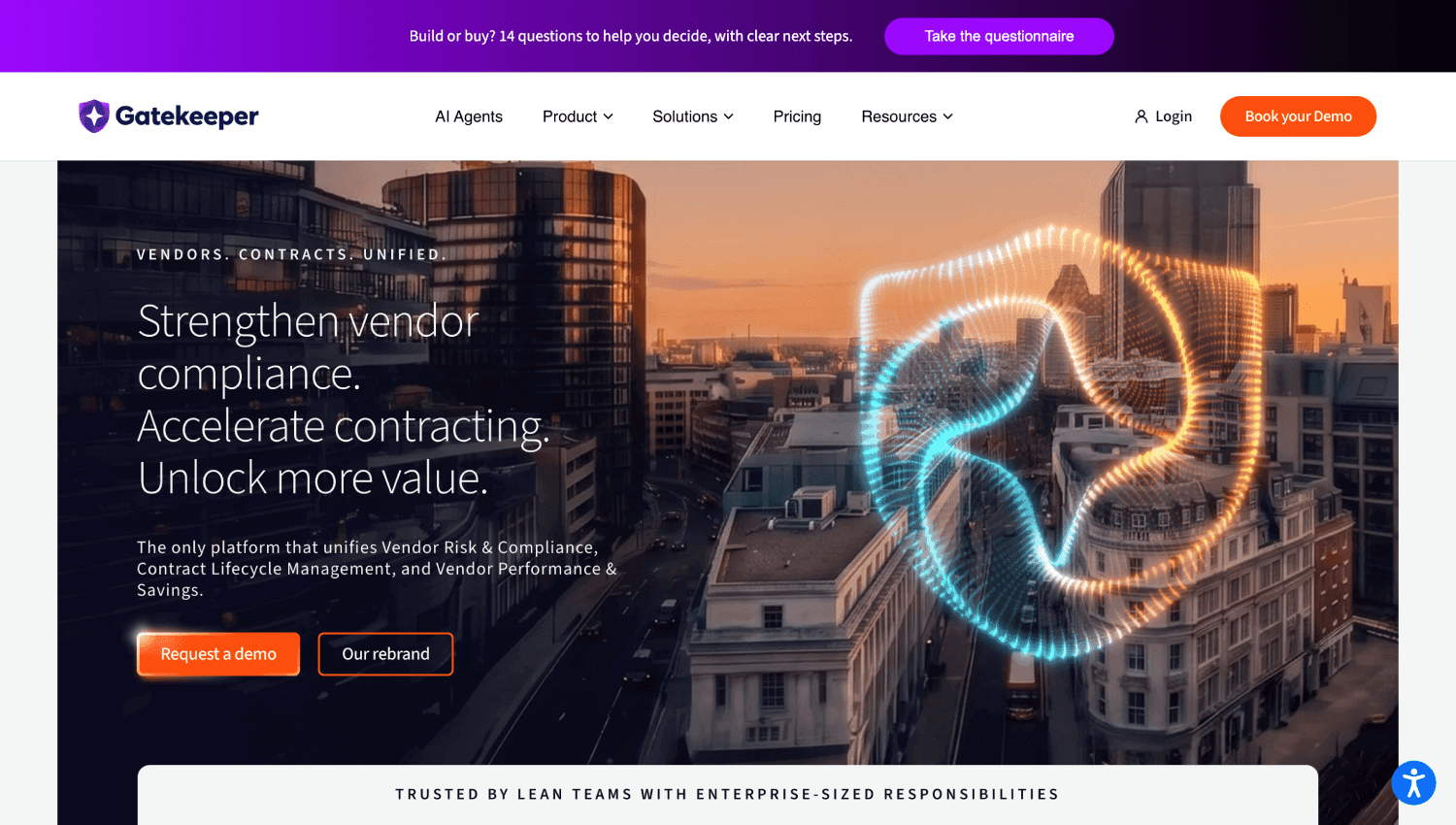
Best for: Teams that want vendor onboarding and contracting on one vendor record.
Gatekeeper runs vendor onboarding, risk screening, and contracting in one workflow, with contracts, spend and performance on each vendor’s record. It says it offers 50+ AI agents built on that one record, and it lists a two-way NetSuite sync.
Plans are sized by the number of third parties you manage, from up to 250 on Pro, with unlimited users. It's the better fit when vendor risk and onboarding matter as much as the contract itself.
Tools for contracts that start on your own templates
5. Ironclad
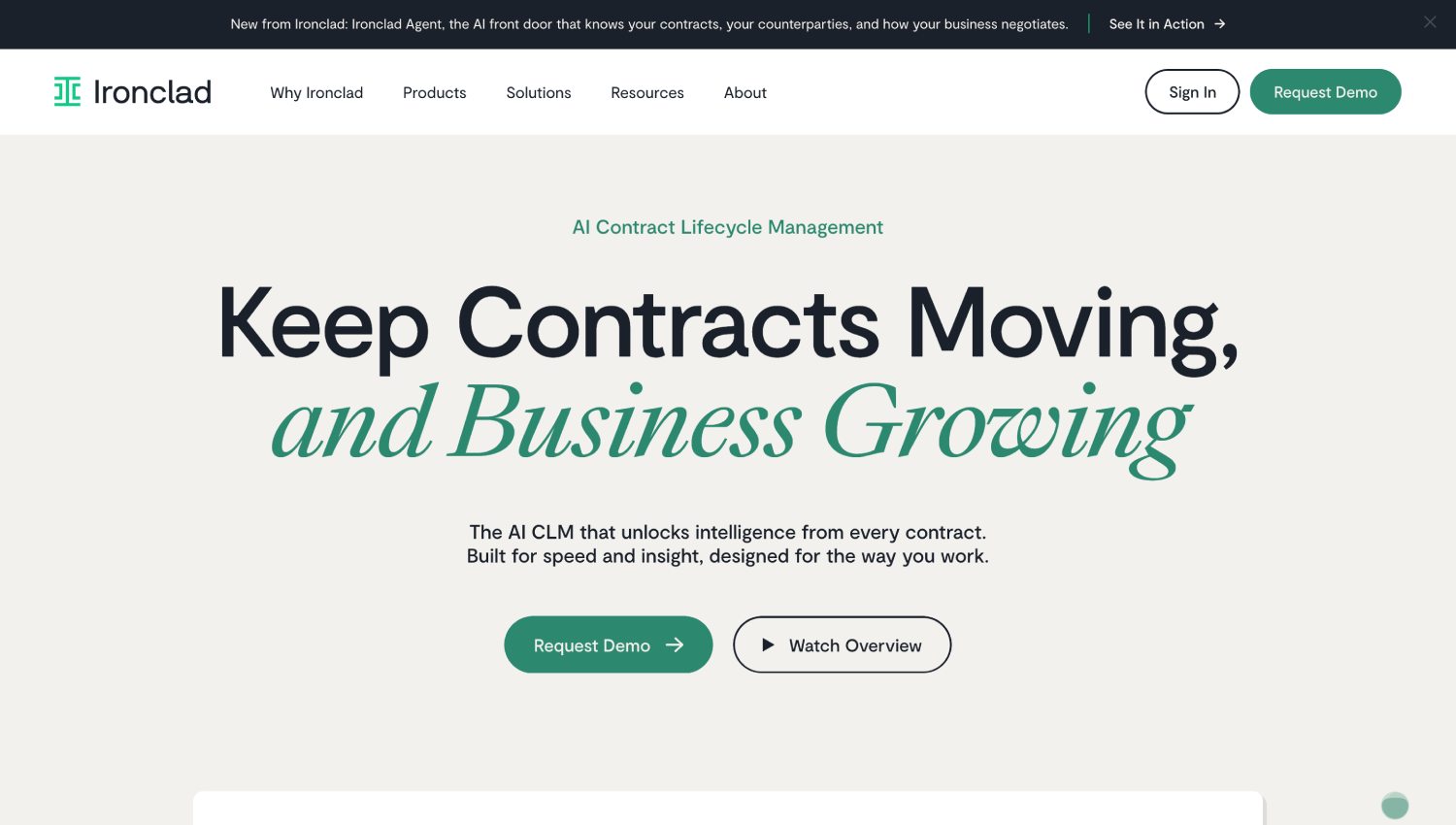
Best for: Legal-led teams handling high volumes of sales and third-party paper.
Ironclad pairs a no-code Workflow Designer with Jurist, its AI assistant for drafting, review, and research. Its Intake Agent reads third-party paper and pre-fills launch forms, and Ironclad turned it on for all customers in April 2026.
Ironclad announced Jurist Redlining Agent with Playbooks as generally available in 2026, and its help center says playbook redlining starts with a Jurist Services engagement, while redlining with precedents is invitation-only early access.
Its Salesforce integration is approved on AppExchange, and it lists a Coupa integration for procurement teams. Pricing is a custom quote shaped by products, users, and workflows, with some integrations sold as add-ons.
Ironclad suits you better than the rest when legal owns contracting across sales, procurement, and HR and wants one mature workflow engine for all of it. Ask in the demo which agents are generally available on your plan today.
6. Docusign CLM
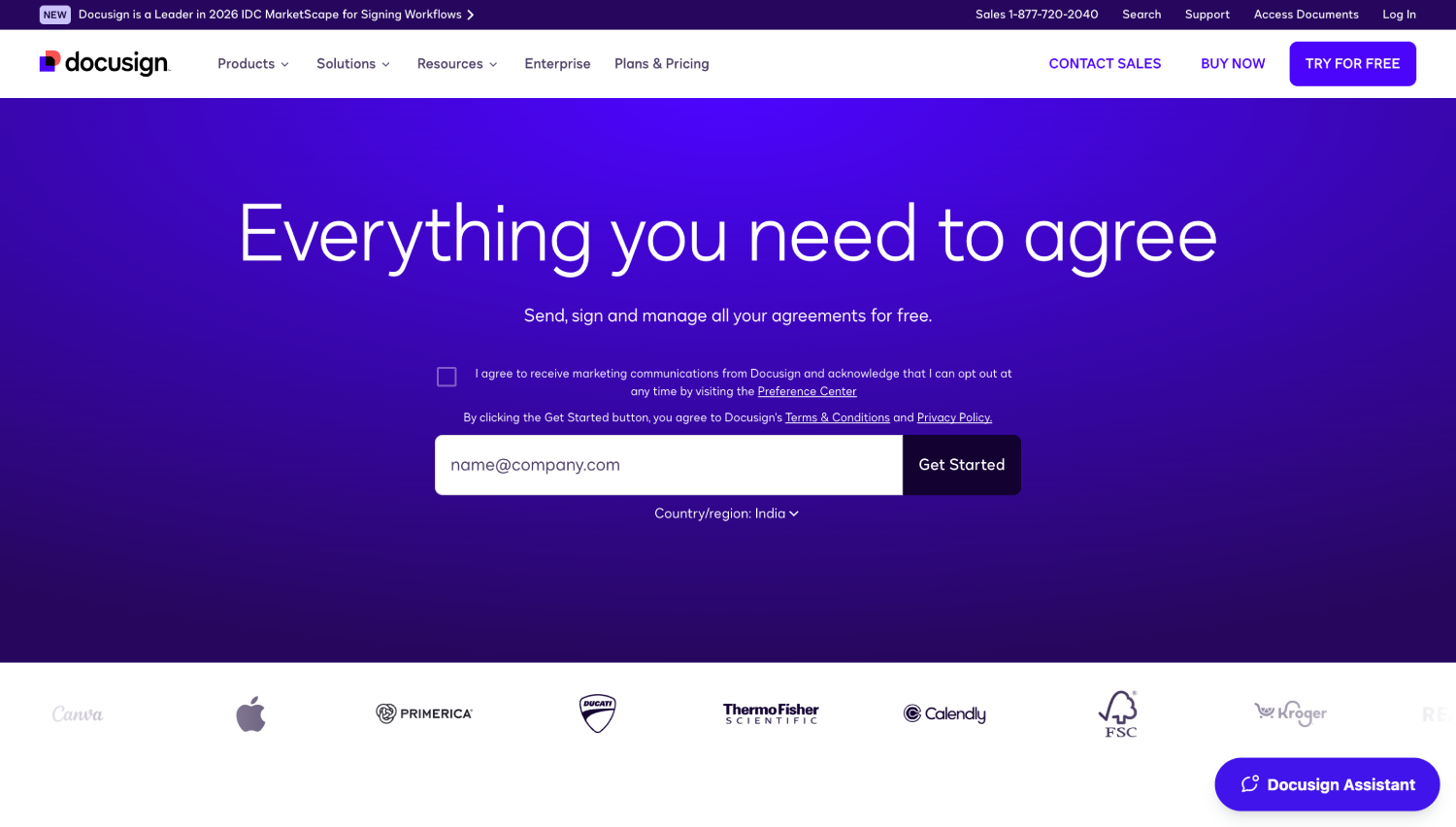
Best for: Organizations already on Docusign eSignature that want a repository with AI.
Docusign sells its CLM within its Intelligent Agreement Management (IAM) platform, built on the Iris AI engine. Every IAM plan includes AI-powered data extraction and an Agreement Manager repository with renewal management.
Request intake, approvals, and redlining start in the upper tiers, and AI-Assisted Review sits in the Enhanced plans sold through sales. Docusign announced an AI assistant, agents, and Agent Studio in May 2026.
Its developer guide says they became generally available in July 2026, in English, for customers hosted in North America data centers on IAM Professional and higher plans.
Go with it when the signature volume is high and you want contract data from the documents you already send. For procurement, its CLM Connector for Coupa turns a purchase request in Coupa into a contract in Docusign CLM. IAM plans are priced per user and published on Docusign’s site (checked October 2026).
7. Agiloft
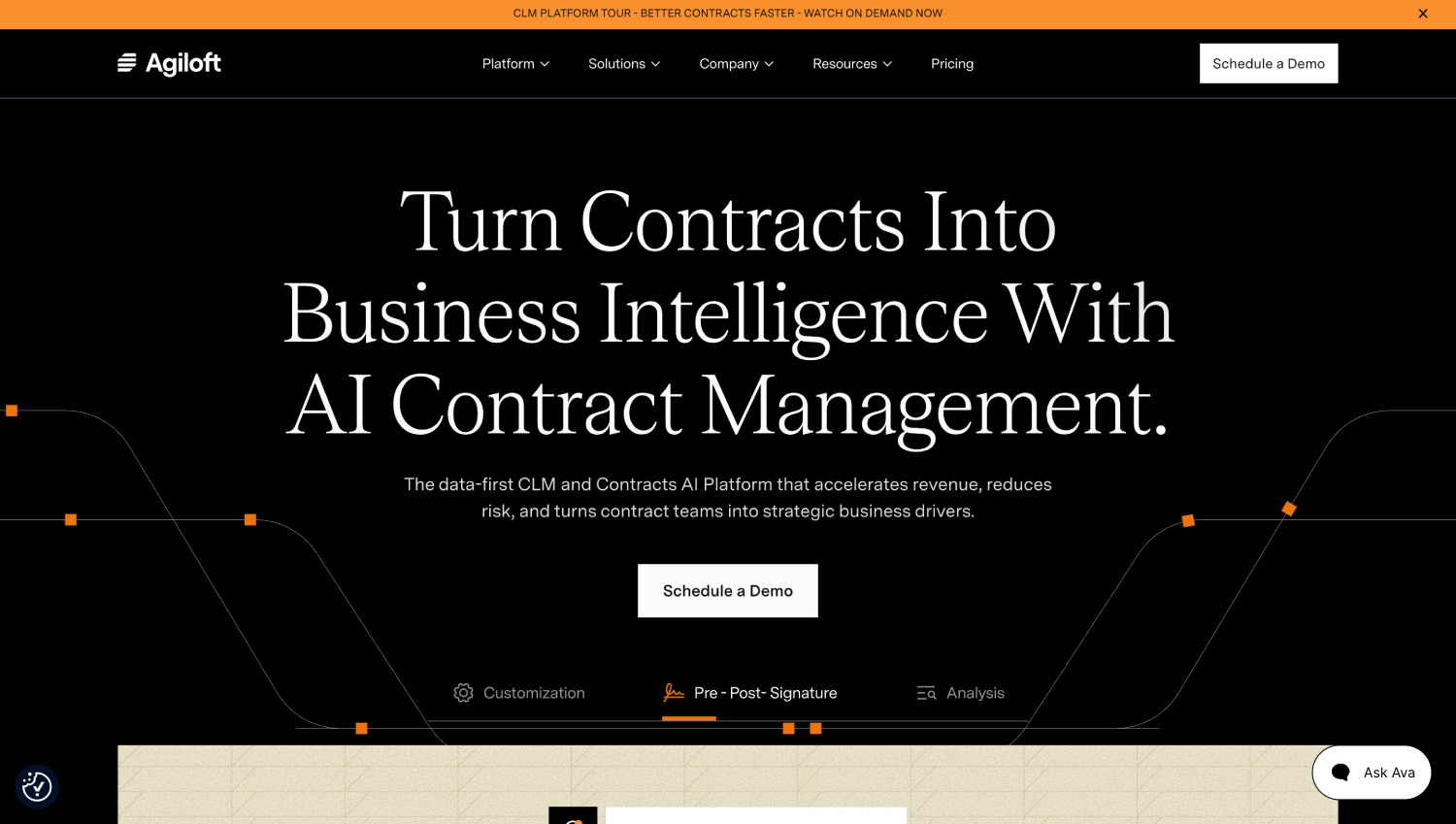
Best for: Enterprises that need contract workflows configured to an unusual process.
Agiloft suits teams whose process doesn’t fit a standard CLM. Approved team members build approval chains and routing logic without code, and Astra, its contracts AI, works before and after signature. An Integration Hub connects contract data to other systems.
The trade-off is ownership: a heavily configured CLM needs someone to keep it configured. Pricing comes by quote.
8. Juro
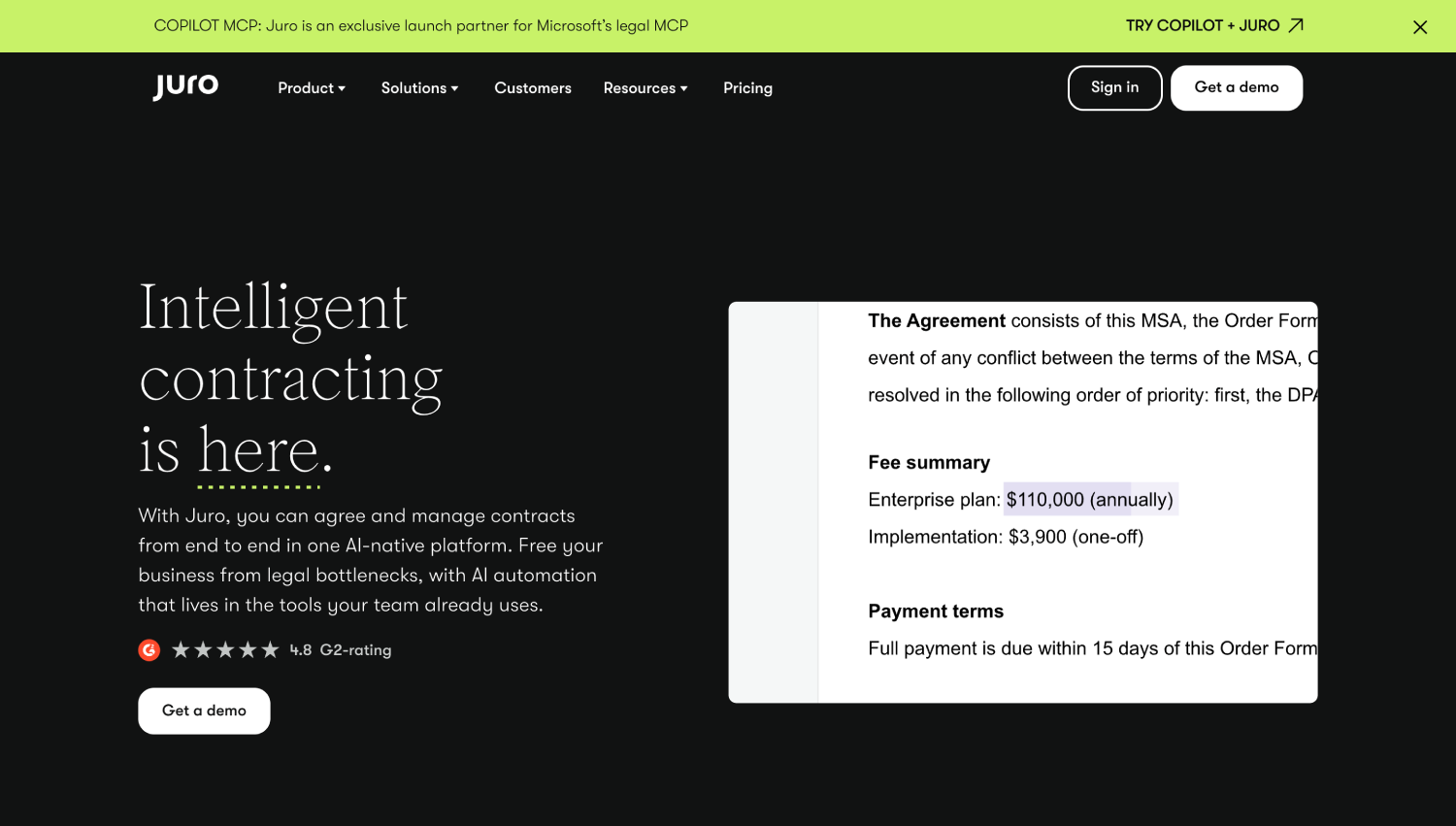
Best for: Scaleup legal teams agreeing sales-side contracts quickly.
Juro calls itself an AI-native platform. Its AI agents triage, review, and redline third-party contracts against your playbooks, and its assistant, Operator, answers questions about your contracts and cites its sources. It connects to Salesforce, HubSpot, Slack, Word, and Docusign.
Juro builds its pricing around contract volume and integration complexity, quoted through a demo. In-house legal, not procurement, is its center of gravity.
9. SpotDraft
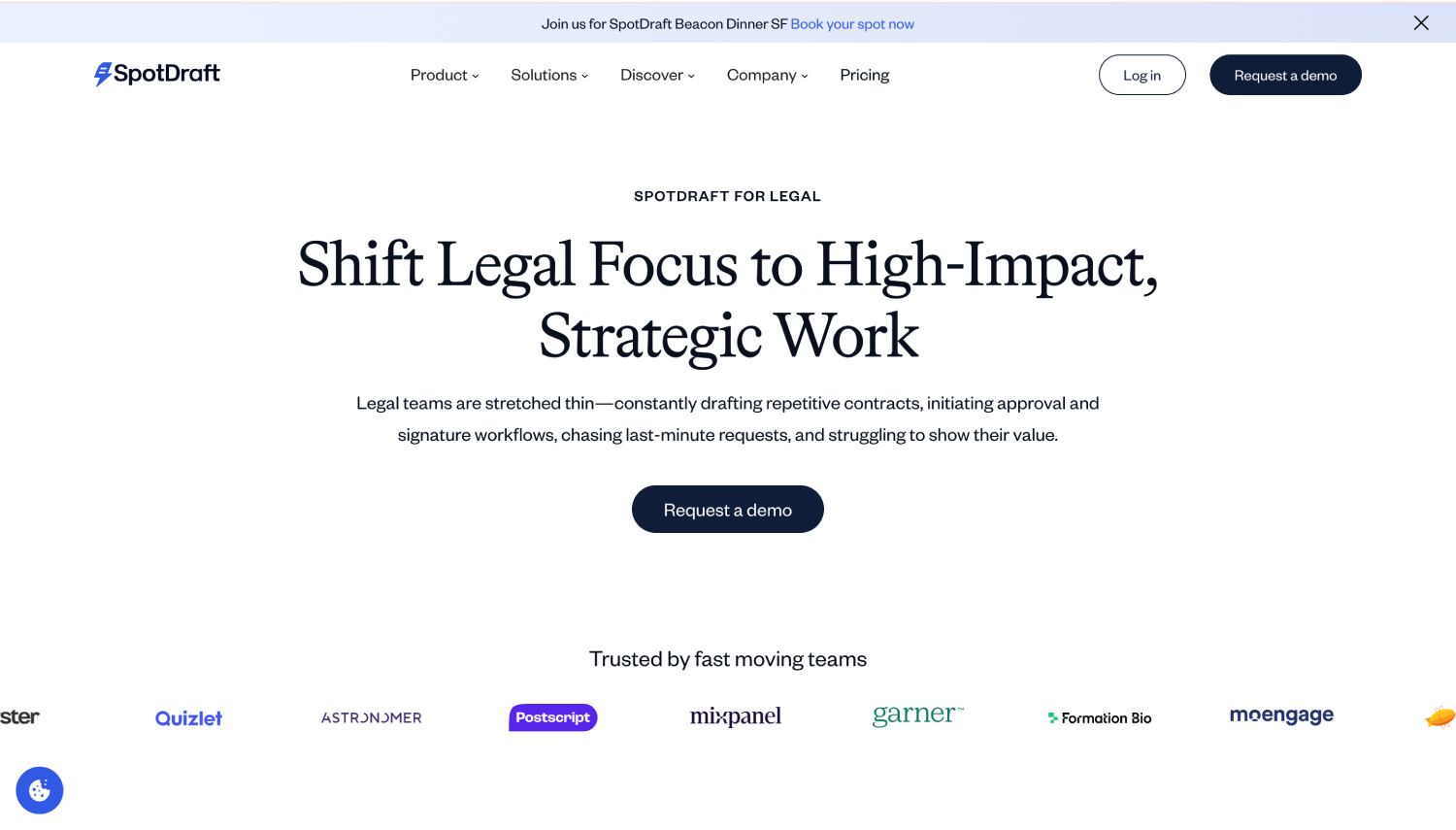
Best for: In-house legal teams that review contracts in Microsoft Word.
For teams that review in Word, SpotDraft’s VerifAI works inside Word itself, and its repository uses AI to pull over 1,000 types of contract metadata.
SpotDraft prices by contract volume and says in-house implementation, including legacy contract migration, is always included. Purchase intake and spend sign-off sit outside its core, so procurement-led teams will feel the gap.
Tools for contracts you have already signed
10. Workday Contract Lifecycle Management
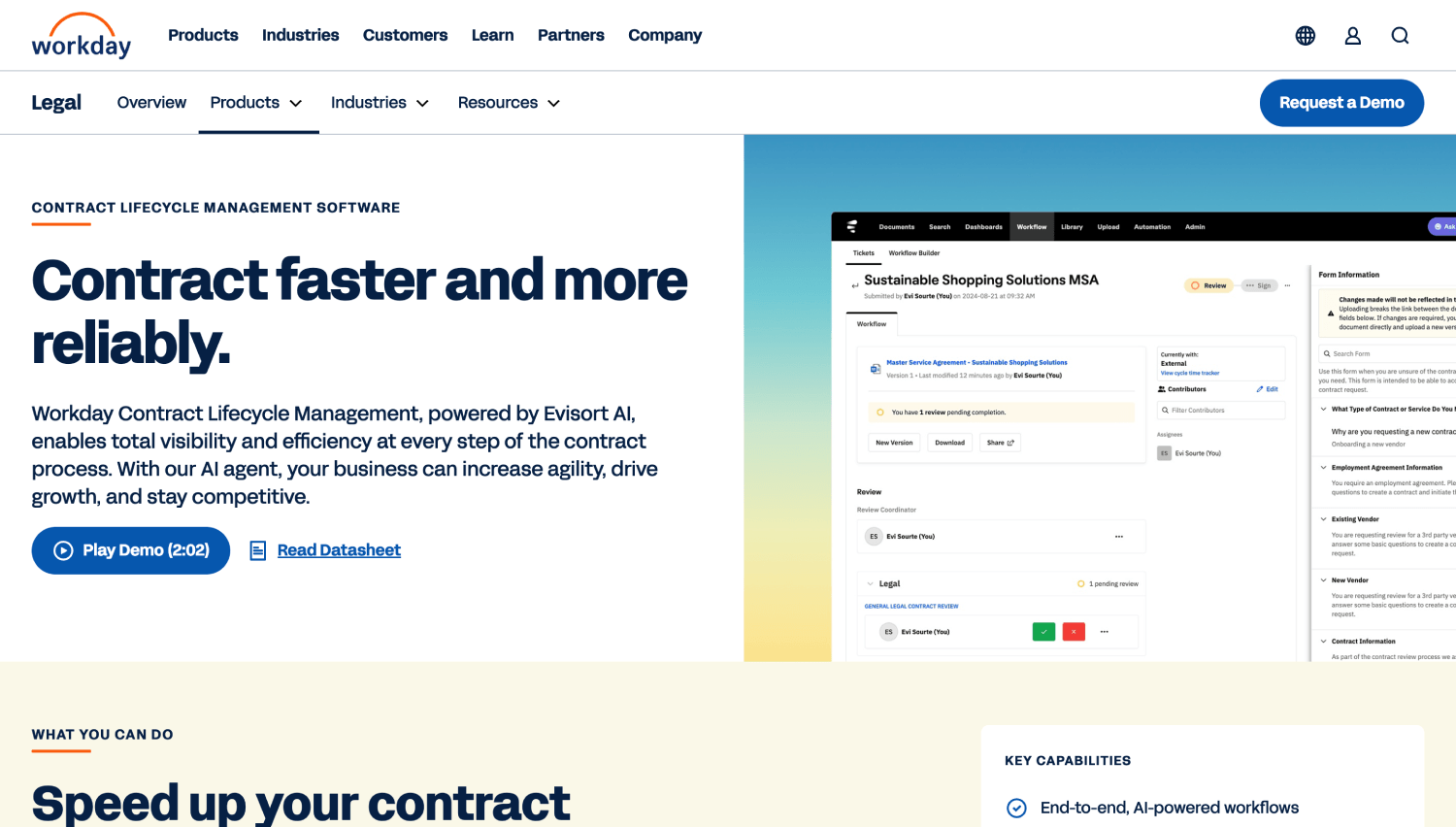
Best for: Organizations with a large backlog of signed contracts nobody can search.
Workday Contract Lifecycle Management is powered by Evisort AI. It includes custom AI models you train to track the terms you care about, "Ask AI" across all contracts, automated redlining and a clause library.
Workday also sells the AI layer on its own as Workday Contract Intelligence, which can sit on top of an existing CLM, and says that product takes 21 days to implement on average. It syncs contracts and data points with repositories such as Box, SharePoint, and Salesforce.
Start here when the first job is finding out what your existing contracts commit you to, before you redesign how new ones get made. It fits most naturally where Workday already runs HR or finance. Workday doesn’t list prices on its contract management pages, so expect pricing on request (checked October 2026).
Which AI Features Matter Most for Supplier Contracts?
For supplier contracts, five AI features pay back first: clause review against your buy-side positions, extraction of renewal and notice dates, and obligation tracking with named owners. Approval routing by value and category, and plain-language search, complete the five. Ask each vendor which of these features are generally available today.
Plan, region, and setup decide what you actually get. Some agents ship only on upper plans or in one hosting region, and some need a vendor services engagement before they work, so a demo can show features your plan won’t include. Ask for the plan name next to every feature you see.
Take an MSA that renews automatically for 12 months unless you give 90 days' notice, expiring June 30, 2027. A spreadsheet holds that date only if someone typed it correctly. A tool that reads the clause should calculate an April 1, 2027 notice deadline, assign an owner, and alert them with time left to renegotiate.
Test exactly that, with a contract whose notice period sits in an amendment rather than the main agreement.
| Capability | Basic automation | What AI adds | Live demo test |
|---|---|---|---|
| Clause review | Keyword match on "indemnify" | Compares the clause's meaning with your playbook position | Upload a third-party MSA with a reworded liability cap |
| Drafting | Template fields filled from a form | First draft from approved clauses and request details | Ask for a variation the template doesn't cover |
| Search | Exact-phrase search | Plain-language questions answered with the source clause | Ask which suppliers can raise prices at renewal |
| Renewal alerts | Reminder on a date someone typed | Notice period read from the signed contract | Use a contract whose notice term sits in an amendment |
| Agent actions | Fixed routing rules | Agent acts inside your rules and logs the decision | Ask to see the audit entry for one agent action |
AI still misreads clauses, and OCR struggles with poor scans. Keep a person on any change to liability, data protection, or uncapped spend.
How Much Do AI Contract Management Tools Cost in 2026?
Most vendors in this list don't publish prices. They quote on contract volume, users, and modules. Budget for the license, AI usage limits, migration of legacy contracts, integrations, and admin time. Then test the spend with a simple ROI model built on your own contract volume and hourly cost.
Docusign is the one vendor here that lists prices, so price the tier that holds the workflow you need rather than the entry plan. FlowForma Contract is priced separately from FlowForma’s Process Automation plans, and its pricing is listed as on request on FlowForma’s pricing page.
Before you sign, ask each vendor about five things: AI usage limits, the cost of migrating old contracts, which integrations are add-ons, weekly admin time, and how renewal pricing is set.
How to calculate ROI
Here is a hypothetical model. Your team handles 200 contracts a month, and the software saves 30 minutes of manual work on each one. That's 100 hours a month, or 1,200 hours a year.
At a loaded cost of $75 an hour, gross savings come to $90,000 a year. Against $30,000 in annual software cost, net savings are $60,000, a 200% first-year return before implementation costs.
Replace every number with your own, and leave out benefits you can't measure, such as avoided renewals.
How Do You Move Supplier Contracts Off Spreadsheets?
Replacing a contract spreadsheet should begin with a pilot on 30 to 50 real contracts, including scanned PDFs, amended agreements, and third-party paper. Check every extracted date, notice period, and owner against an answer key your team builds. Move the rest only after the tool catches every high-risk clause in the sample.
Build the answer key before the vendor sees the files. Have someone who knows the contracts record the counterparty, effective and expiry dates, notice period, payment terms, liability cap, governing law, and the internal owner for each one. Then compare line by line. A tool that gets 49 of 50 notice periods right still fails if the miss is your largest supplier.
Pick three awkward files on purpose: a poor-quality scan, an agreement with several amendments, and supplier paper with headings that don't match your templates. Check whether each extracted value links back to the exact clause it came from. If it doesn't, your team will end up re-reading the contract anyway.
Ownership is where spreadsheets fail quietly. When a contract owner leaves, the spreadsheet keeps the date but loses the person. In FlowForma Contract, for example, an obligations agent reads the signed contract and records key dates, notice periods and obligations with their owners, which is the behavior to test in every pilot.
How Do You Choose the Right AI Contract Platform?
Choose by where your contracts start and what they must connect to. Procurement-led teams need request intake, approval rules, and supplier records. Legal-led teams need drafting, playbook redlines, and e-signature, while teams with signed backlogs need extraction first. Then give every shortlisted vendor the same scripted demo, using your contracts.
Use this rule: If contracts start as purchase requests or tenders with approvals across teams, choose from the first group, because the contract has to stay tied to the spend decision behind it. If contracts start on your own templates, choose from the second group, because drafting and redlining are the job. If signed contracts can't be searched, start with the third group, because extraction comes first.
Within those groups, the facts point to these matches:
Procurement, finance and legal approving purchases, tenders, and contracts together: FlowForma Contract.
A global enterprise on SAP Ariba: Icertis.
Outsourced services managed on SLAs and invoices: Sirion.
Vendor risk and onboarding as the main concern: Gatekeeper.
Legal owning high-volume contracting across departments: Ironclad.
Contract workflows configured to an unusual process: Agiloft.
Heavy Docusign eSignature use: Docusign CLM.
A scaleup legal team on sales paper, or a team that lives in Word: Juro or SpotDraft.
A backlog of signed contracts, especially in a Workday estate: Workday CLM.
Then run the same eight-step demo with every finalist:
Load an unfamiliar third-party agreement.
Extract its key terms.
Flag its risky language.
Propose a playbook-compliant revision.
Route an approval by value.
Capture a signature.
Set the renewal alert.
Find a clause with a plain-language question.
Frequently Asked Questions
1. Do AI contract tools train AI models on your contracts?
It depends on the vendor, so ask in writing whether your contracts train any model. Policies differ: Ironclad, for example, keeps “do not train” terms with outside LLM providers but lets customers opt in to training its own models. Ask which model providers process your contracts, where processing happens, and how uploads are deleted after you leave.
2. Can AI contract software negotiate contracts without a lawyer?
No, AI contract software can't take that role, because your organization stays legally accountable for every term it accepts. AI can suggest redlines and apply an approved playbook to routine terms. A person should still approve changes to liability, data protection, termination rights or uncapped commitments. Write those limits into the playbook before the first contract runs through it.
3. How long does it take to implement an AI contract platform?
Implementation time for an AI contract platform depends on contract volume, data quality, integrations and approval paths. Migrating thousands of scanned legacy contracts takes longer than starting with new agreements, and each ERP or CRM connection adds testing. Ask each vendor for a scoped plan with named milestones, because a timeline without scope is a guess.
4. When is dedicated AI contract management software unnecessary?
A dedicated platform is hard to justify when one person owns a few dozen contracts with simple approvals, because a spreadsheet and calendar reminders still cope. That changes once several teams approve contracts, third parties send their own paper, or a renewal slips past its notice date. If two of those three are true, start evaluating tools.
5. Can AI contract tools work alongside a procurement suite or tender portal?
Yes, AI contract tools can sit alongside them, and many teams keep their source-to-pay suite or e-tendering portal. Ironclad and Docusign both list Coupa integrations. FlowForma Contract can run the internal approvals, scoring workflow, award sign-off and contract management around an existing tender portal. Integration works best when one system owns the contract record.
Closing Thoughts
The right AI contract management software shows itself on your own contracts, not in a ranking. Shortlist the group that matches where contracts begin in your organization, then run the same pilot and demo script with every finalist.
Teams in the first group can see how request-to-renewal approvals run on their own rules in a FlowForma Contract demo.
Tags
About the Author
Helping firms leverage AI for growth and efficiency
Related Articles


See how AI agents fit your team
US Tech Automations builds and runs the AI agents that handle this work end to end, so your team doesn't have to.
View pricing & plans